VIP
Gut-brain and motility-context peptide with high systemic caution.
VIP in Gut Health is framed as enteric nervous system / smooth muscle / secretion / vasodilation. The report separates mechanism, human gut-health outcome evidence, and regulatory status.
VIP helps explain gut-brain, motility, ibs-like instability, and neuroenteric context. For Ana, it is evaluated against bloating, food triggers, suspected permeability, anxiety-linked gut unpredictability, Hashimoto, PCOS, metformin use, and lack of a confirmed IBD/SIBO diagnosis.
Why it may make sense for you
For Ana, VIP appears because the Gut Health profile combines persistent bloating, multiple food triggers, suspected permeability, anxiety around intestinal unpredictability, Hashimoto, PCOS, metformin use, and no robust formal GI diagnosis.
| Signal | Interpretation |
|---|---|
| Primary symptom pattern | Constant bloating and food-triggered symptoms |
| Barrier question | Suspected leaky gut / permeability |
| Inflammatory context | Hashimoto, PCOS, low-grade inflammation |
| Gut-brain context | Anxiety linked to intestinal unpredictability |
| Diagnostic boundary | No confirmed IBD, SIBO, celiac disease, or short bowel syndrome |
- Ana links anxiety to intestinal unpredictability and reports symptom instability rather than one confirmed diagnosis.
- The dossier helps separate barrier, inflammation, motility, dysbiosis, and regulated GLP-2 categories.
- Ana has enough gut-context signals for education to be useful.
- Vasoactive/systemic caution keeps VIP behind barrier and inflammatory candidates.
- Food triggers and bloating can reflect intolerance, celiac disease, IBS, SIBO, medication effects, reflux, thyroid context, or inflammatory disease.
- Red flags should move the conversation to medical evaluation, not peptide matching.
How it works
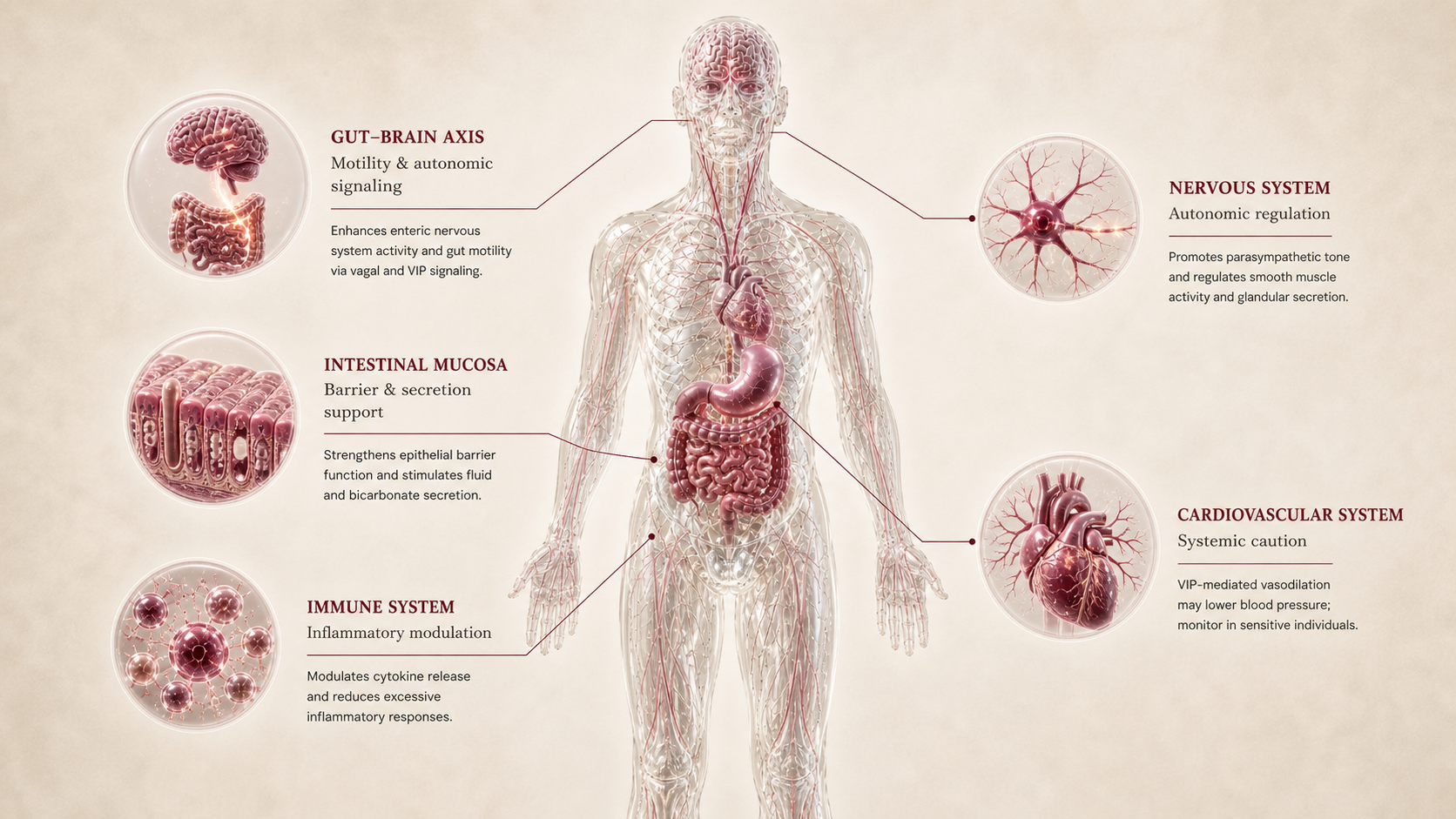
VIP is an endogenous neuropeptide involved in enteric signaling, smooth-muscle relaxation, secretion, blood-flow regulation, immune signaling, and the gut-brain axis. In this niche, it maps instability more than structural repair.
| Pathway | Practical effect |
|---|---|
| Mechanistic evidence | Enteric nervous system / smooth muscle / secretion / vasodilation. |
| Human gut-health outcome evidence | Consumer gut-health outcome evidence is limited and context-specific; VIP biology should not be translated into an IBS protocol. |
| Regulatory / label evidence | There is no broad approved gut-health label for VIP. Product identity, route, and systemic effects matter. |
| Ana relevance | Gut-brain, motility, IBS-like instability, and neuroenteric context. |
VIP is useful for understanding one gut pathway, but a pathway is not the same as diagnosis, treatment, or a protocol.
What the evidence shows
VIP is framed through three evidence layers: mechanism, human gut-health outcomes, and regulatory/label status. Peptivius keeps these separate so gut-health marketing does not turn a plausible pathway into a treatment claim.
| Study | Population | Key result | How to read it |
|---|---|---|---|
| Mechanistic evidence | Enteric nervous system / smooth muscle / secretion / vasodilation. | VIP is an endogenous neuropeptide involved in enteric signaling, smooth-muscle relaxation, secretion, blood-flow regulation, immune signaling, and the gut-brain axis. In this niche, it maps instability more than structural repair. | Explains why the peptide appears in Gut Health discussions. |
| Human gut-health outcome evidence | Outcome translation | Consumer gut-health outcome evidence is limited and context-specific; VIP biology should not be translated into an IBS protocol. | Determines how far the claim can go. |
| Regulatory / label evidence | Research Only | There is no broad approved gut-health label for VIP. Product identity, route, and systemic effects matter. | Defines practical boundary and approved-context status. |
- Whether the user's symptoms are IBS, IBD, SIBO, reflux, intolerance, celiac disease, medication-related, thyroid-linked, or another pattern.
- Whether human evidence supports the same claim being discussed in forums.
- Whether product identity, route, formulation, or source quality changes the risk profile.
Safety, side effects, and contraindications
- Gut symptom attribution can be unclear.
- Route/formulation uncertainty can change interpretation.
- Placebo, diet changes, and co-interventions can dominate perceived effects.
- Vasoactive/cardiovascular effects, blood pressure context, short half-life, and systemic action.
- Blood in stool, anemia, fever, nocturnal diarrhea, progressive pain, persistent vomiting, dysphagia, dehydration, or unintentional weight loss require evaluation.
- Active IBD, suspected infection, immunosuppression, chronic corticosteroid use, pregnancy, or cancer history need professional review.
- Research-only, compounded, and grey-market products are not equivalent to approved gut medications.
- Red-flag GI symptoms without evaluation.
- Known or suspected obstruction, severe dehydration, acute abdomen, or rapidly worsening abdominal pain.
- Active serious infection or uncontrolled inflammatory disease without clinician oversight.
- Pregnancy or lactation without medical supervision.
- Using a peptide to delay diagnosis or standard care.
For Ana, VIP should be read through the fact that symptoms are persistent but not yet diagnostically settled. The priority is pattern clarity, food-trigger mapping, labs/testing when appropriate, and red-flag screening.
Reference protocol
Research-sensitive mechanism context: Vasoactive intestinal peptide enteric nervous system, microbiota, motility, and neuroimmune literature.
- Diagnosis, medical evaluation, endoscopy, stool testing, breath testing, celiac workup, or gastroenterology care.
- A personal protocol, dose plan, stack, supplier path, or treatment recommendation.
- Community protocols, compounded blends, or research-only products marketed as gut-healing solutions.
| Item | Reference |
|---|---|
| Reference frame | High-caution gut-brain and motility context |
| Gut role | Gut-brain, motility, IBS-like instability, and neuroenteric context. |
| Evidence layer | Biologically important in the gut-brain and enteric nervous system; limited as consumer Gut Health intervention. |
| Practical readiness | Low; systemic and vasoactive effects make it a high-caution education topic. |
| Not a protocol | No dose, timing, cycle, vial, syringe, unit, or supplier guidance. |
- Clarify the symptom pattern, food triggers, medication context, prior workup, and red flags.
- Separate barrier, inflammation, motility, reflux, dysbiosis, celiac, and malabsorption hypotheses.
- Use professional review when symptoms are severe, progressive, inflammatory, or unexplained.
- Read VIP as high-caution gut-brain and motility context, not as a consumer use plan.
- Keep mechanism, human outcome evidence, and regulatory status separated.
- Avoid treating gut discomfort as one universal category.
- Track symptoms, stool pattern, food tolerance, reflux, energy, weight change, hydration, and new red flags.
- Escalate evaluation rather than peptide experimentation when alarm features appear.
- Treat stopping, deferring, or seeking workup as a valid conclusion.
| Item | Reference |
|---|---|
| Reference mode | High-caution gut-brain and motility context |
| Primary anchor | Vasoactive intestinal peptide enteric nervous system, microbiota, motility, and neuroimmune literature. |
| Route label | Intranasal as category descriptor, not instruction. |
| Timing | No consumer protocol timeline. |
| Decision points | Diagnosis, red flags, food triggers, medications, labs/testing, and professional review. |
- Is this barrier, inflammation, motility, reflux, dysbiosis, celiac, or malabsorption?
- Are red flags present?
- Has a clinician ruled out conditions that should not be self-managed?
- Would a peptide obscure the diagnosis or reduce clarity?
- Is the evidence layer being confused with a treatment plan?
- Which gut hypothesis is most relevant.
- Which tests or clinical review are needed.
- How food triggers, stress, medication, and thyroid/metabolic context change the interpretation.
- Red-flag triage.
- Approved indication boundaries.
- The difference between research-only peptides and approved medications.
- Avoidance of dose conversions, cycles, blends, and supplier guidance.
Administration is included only as category literacy. The report does not instruct the reader to administer a gut peptide.
- Route labels in the report are descriptive, not recommendations.
- Gut peptides are especially easy to over-market because symptoms are common and nonspecific.
- Product identity, route, formulation, and source quality can dominate safety interpretation.
Gut Health maintenance is about diagnostic clarity, symptom stability, sustainable diet, and professional care when needed.
- Track food tolerance and symptom patterns rather than chasing a peptide timeline.
- Revisit labs, stool markers, or gastroenterology evaluation if symptoms persist.
- Do not use peptides to delay care for inflammatory, bleeding, obstructive, or malabsorptive patterns.
| Question | Reference answer |
|---|---|
| Is this a gut protocol? | No. It is mechanism and evidence literacy. |
| Can this replace a gastroenterologist? | No. Diagnosis and red-flag evaluation come first. |
| Can I treat SIBO, IBD, or leaky gut with this? | The report does not make that recommendation. |
| Why include regulatory anchors? | They show what approved gut peptide evidence looks like, and where the boundaries are. |
Reference context only. This dossier does not provide a dose, schedule, duration, cycle, vial conversion, syringe unit, supplier path, or personal protocol.
- Do not treat gut discomfort as one universal peptide problem.
- Do not use peptide matching to delay evaluation of red flags.
- Do not infer a stack, blend, or protocol from mechanism overlap.
- Do not treat research-only products as equivalent to approved medications.
Monitoring and labs
- Bowel pattern, stool frequency, urgency, constipation, diarrhea, and nocturnal symptoms.
- Pain, bloating, reflux, nausea, vomiting, hydration, and weight trend.
- Food triggers: gluten, lactose, FODMAPs, meal timing, alcohol, caffeine, and supplements.
- Medication context: metformin tolerance, thyroid medication, acid suppression, NSAIDs, antibiotics, and probiotics.
- Prior workup: celiac testing, stool tests, SIBO breath testing, endoscopy history, fecal calprotectin if applicable.
- CBC, ferritin, B12, vitamin D, inflammatory markers, and thyroid/metabolic context when relevant.
- Symptom frequency and intensity.
- Food tolerance and trigger consistency.
- Diarrhea, constipation, reflux, pain at night, hydration, energy, and weight.
- New red flags or symptom progression.
- Whether a structured diet or clinical evaluation has clarified the pattern.
- Stable symptom pattern and known triggers.
- Sustainable diet strategy rather than endless restriction.
- Need for gastroenterology follow-up or further testing.
- Response to conventional care when indicated.
- Relationship with sleep, stress, anxiety, and gut-brain patterns.
The goal is not just reducing discomfort. It is understanding the pattern, identifying red flags, avoiding overclaiming, and building a safe strategy.
Regulatory status & study stage
There is no broad approved gut-health label for VIP. Product identity, route, and systemic effects matter.
| Item | Status | How to read it |
|---|---|---|
| Status | Research Only | Interpret only inside the stated anchor. |
| Gut indication | Gut-brain, motility, IBS-like instability, and neuroenteric context. | Not all gut roles are clinical indications. |
| Readiness | Low; systemic and vasoactive effects make it a high-caution education topic. | Practical readiness is separate from mechanism interest. |
- Consumer gut-health outcome evidence is limited and context-specific; VIP biology should not be translated into an IBS protocol.
- Gut symptoms require diagnostic context before outcome claims can be interpreted.
- Low; systemic and vasoactive effects make it a high-caution education topic.
- No supplier, dose, or protocol guidance is provided.
This dossier does not convert label, trial, research, or comparator context into consumer instructions.
Stacking and synergies
VIP may appear in gut-healing stacks online, but Peptivius keeps combination literacy at the niche level. This dossier evaluates the individual peptide.
- Symptom journal, food-trigger mapping, hydration, and bowel-pattern tracking.
- Clinician-guided testing when celiac disease, IBD, SIBO, malabsorption, or reflux complications are possible.
- Sleep and stress support when gut-brain patterns are present.
- Multiple gut peptides layered without a diagnosis.
- Barrier plus antimicrobial plus immune peptides used as a broad gut-healing blend.
- Adding peptides while ignoring metformin tolerance, thyroid context, or dietary triggers.
- Blood, anemia, weight loss, nocturnal diarrhea, severe pain, vomiting, or dysphagia.
- Known IBD, celiac disease, immunosuppression, chronic steroid use, or suspected infection.
- Any antimicrobial peptide or GLP-2 class discussion.
A gut stack can reduce clarity. If symptoms change, it becomes harder to know whether food, medication, infection, inflammation, placebo, or a peptide caused the change.
Genetic variable
VIP has no validated consumer genetic response engine in Peptivius today. The genes below are pathway literacy only for barrier, immune, motility, celiac, or microbiome-related interpretation.
- No validated genotype determines whether this peptide is appropriate for Ana.
- Pathway genes may help explain barrier, immune, motility, or celiac-risk differences.
- No SNP should convert gut symptoms into a peptide recommendation.
Future DNA layers may refine gut interpretation, but Slice 1 does not personalize gut peptides from genotype.
Real-world reports
- Gut-health anecdotes often mix peptides with elimination diets, probiotics, antibiotics, supplements, and stress changes.
- Users frequently report nonspecific symptoms such as bloating, reflux, constipation, or food reactivity without a confirmed diagnosis.
- Research-only product quality and route claims are recurring concerns.
- New red flags or symptom progression.
- Unclear diagnosis or worsening GI symptoms.
- Concern that a peptide is masking the need for standard evaluation.
- Anecdotes can reveal what users ask, but they do not prove gut-health efficacy.
- The strongest interpretation comes from diagnosis, symptom tracking, labs/testing, and response to conventional foundations.
- Blend marketing should be decomposed into component mechanisms.
Final personalized interpretation
For Ana, VIP is best read through a diagnostic-clarity lens. The profile has meaningful gut signals: persistent bloating, suspected permeability, gluten/lactose/FODMAP triggers, anxiety around unpredictability, Hashimoto, PCOS, metformin exposure, and low-grade inflammatory context.
That does not mean the problem is automatically leaky gut, SIBO, IBD, or reflux. It means the report should separate barrier, inflammation, gut-brain, motility, dysbiosis, celiac/permeability, and regulated GLP-2 concepts before any peptide receives too much credit.
VIP is useful because it explains one part of that map. It does not replace gastroenterology review, red-flag triage, stool/lab testing when appropriate, structured diet work, or medication review.
For Ana, VIP should be read as Gut Health education, not a protocol or treatment instruction.