Thymosin Alpha-1
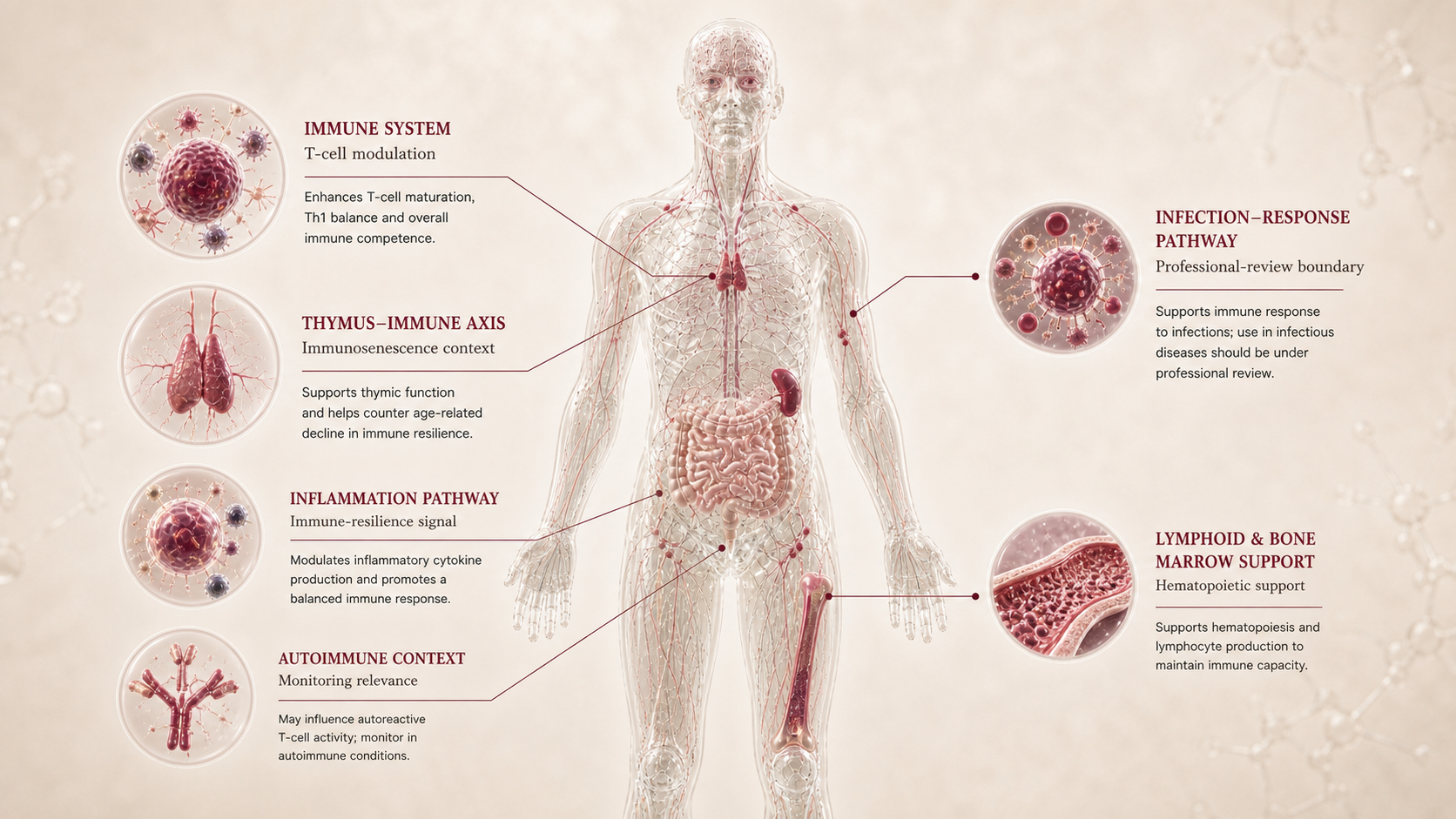
Thymosin Alpha-1 is included in Longevity as immune aging, immunosenescence, chronic inflammation, and resilience literacy.
Immune modulation / T-cell context / immune resilience. Thymosin Alpha-1 is used or approved in some jurisdictions for specific immune, infectious, or hepatic contexts, but it is not a broad FDA-approved longevity therapy. FDA safety-risk materials flag compounding concerns.
Thymosin Alpha-1 is not framed as a way to live forever or reverse aging. The dossier separates mechanism, human healthspan evidence, regulatory status, monitoring burden, and Ana's metabolic, inflammatory, circadian, and biomarker context.
Why it may make sense for you
For Ana, Thymosin Alpha-1 ranks #5 because Ana has Hashimoto, low-grade inflammation, stress, fatigue, and interest in immune resilience, so immunosenescence literacy matters. Hashimoto and autoimmune context make immune modulation a caution area, not a simple positive signal. Data confidence is Medium: the profile gives a strong healthspan read, but biological-age method, fasting insulin, HOMA-IR, lipids, ferritin, vitamin D, thyroid panel, HRV, VO2, strength, and body-composition trend would sharpen the ranking.
| Signal | Interpretation |
|---|---|
| Healthspan concern | Biological-age worry, fatigue, brain fog, skin/hair changes, and fear of accelerated cellular aging. |
| Metabolic context | PCOS, HbA1c borderline context, metformin use, body-composition concern, and inflammation signal. |
| Category fit | Immune aging, immunosenescence, chronic inflammation, and resilience literacy. |
| Evidence boundary | More human immune-context literature than many longevity peptides, but not broad anti-aging outcome evidence. |
| Main caution | Autoimmunity, Hashimoto, immunosuppression, cancer history, infection status, and immune overconfidence require review. |
- Longevity is relevant because Ana's concerns cluster around metabolism, inflammation, sleep, cognition, and body composition.
- The compound clarifies one major mechanism family inside the healthspan map.
- The ranking is useful for professional conversation, not self-prescription.
- Sleep, training, thyroid/PCOS care, inflammatory workup, and labs may explain more than any peptide.
- Autoimmune, medication, glucose, cancer-history, and psychological context can change interpretation.
- The report does not turn rank into action.
How it works
Thymosin Alpha-1 is discussed around immune modulation, T-cell function, innate and adaptive immune signaling, infection resilience, and immunosenescence.
| Pathway | Practical effect |
|---|---|
| Mechanism family | Immune modulation / T-cell context / immune resilience. |
| Longevity lens | Immune aging, immunosenescence, chronic inflammation, and resilience literacy. |
| Interpretation | Mechanism can explain plausibility, but does not prove lifespan extension, age reversal, or telomere reversal in people. |
Thymosin Alpha-1 helps explain one healthspan pathway, but the pathway only matters if sleep, training, metabolic health, inflammation, body composition, cognition, and safety context make the signal interpretable.
What the evidence shows
Thymosin Alpha-1 has three evidence layers: mechanistic evidence, human longevity or healthspan outcome evidence, and regulatory or label evidence. Peptivius keeps these separate so longevity language does not become a protocol or anti-aging promise.
| Study | Population | Key result | How to read it |
|---|---|---|---|
| Mechanistic evidence | Immune modulation / T-cell context / immune resilience. | Thymosin Alpha-1 is discussed around immune modulation, T-cell function, innate and adaptive immune signaling, infection resilience, and immunosenescence. | Useful for plausibility and category literacy. |
| Human longevity / healthspan outcome evidence | Outcome translation | Human evidence is more relevant to immune, infectious, hepatic, and oncology-adjacent contexts than to general longevity or biological-age reversal. | Limited unless label- or trial-specific evidence says otherwise. |
| Regulatory / label evidence | FDA safety-risk compounding page for thymosin-alpha 1 plus immune-modulation literature and non-US specific-use context. | Thymosin Alpha-1 is used or approved in some jurisdictions for specific immune, infectious, or hepatic contexts, but it is not a broad FDA-approved longevity therapy. FDA safety-risk materials flag compounding concerns. | Defines boundaries and safety framing. |
- Direct human healthspan outcomes are limited for most compounds in this niche.
- Biological-age testing is not a validated response engine for peptide use.
- Long-term safety, product identity, autoimmune context, and medication overlap may dominate practical interpretation.
Safety, side effects, and contraindications
- Local irritation or tolerability issues can occur depending on route and product context.
- Energy, sleep, appetite, glucose, edema, mood, immune symptoms, or training tolerance may change depending on mechanism family.
- Source quality and product identity are core safety variables for research-sensitive compounds.
- Mitochondrial and telomere narratives can be overclaimed beyond human outcome evidence.
- Immune-modulating compounds require autoimmune, infection, immunosuppression, cancer-history, and medication review.
- GH-axis compounds require IGF-1, glucose, edema, sleep-apnea, endocrine, and malignancy-history awareness.
- Biological-age anxiety should not replace medical evaluation when red flags or abnormal labs are present.
- Active malignancy or unresolved cancer history without professional review.
- Active autoimmune disease flare, serious infection, immunosuppression, or unexplained inflammation without diagnosis.
- Uncontrolled diabetes, severe sleep apnea, uncontrolled cardiovascular disease, pregnancy, or lactation.
- Rapid cognitive decline, severe depression, suicidal ideation, chest pain, syncope, unexplained weight loss, or major abnormal labs.
For Ana, the main caution with Thymosin Alpha-1 is that Hashimoto, PCOS/metformin, poor sleep, stress, inflammation, brain fog, and biological-age concern create overlapping causes. A peptide should not obscure the root driver.
Reference protocol
Immune-aging context with jurisdiction-specific clinical history: Thymosin Alpha-1 is anchored to FDA safety-risk compounding page for thymosin-alpha 1 plus immune-modulation literature and non-US specific-use context. This is healthspan education and professional-conversation framing, not a personal longevity protocol.
- An anti-aging prescription
- A biological-age reversal protocol
- A stack recommendation
- A community cycle, vial, syringe, or timing plan
- A claim that research-only material equals an approved medication
- A substitute for sleep, training, metabolic health, medical screening, or biomarkers
| Item | Reference |
|---|---|
| Longevity role | Immune aging, immunosenescence, chronic inflammation, and resilience literacy. |
| Mechanistic evidence | Immune modulation / T-cell context / immune resilience. |
| Human healthspan evidence | Human evidence is more relevant to immune, infectious, hepatic, and oncology-adjacent contexts than to general longevity or biological-age reversal. |
| Regulatory / label evidence | Thymosin Alpha-1 is used or approved in some jurisdictions for specific immune, infectious, or hepatic contexts, but it is not a broad FDA-approved longevity therapy. FDA safety-risk materials flag compounding concerns. |
| Application footprint | Not standardized here; the report does not publish dosing, timing, cycle, or application instructions. |
| Decision points | Sleep, training, body composition, glucose/insulin, inflammation, immune context, cognition, biomarkers, medications, and red flags. |
- Read longevity through sleep, training, muscle, metabolic health, inflammation, cardiovascular risk, cognitive function, and medical screening first.
- Do not use a peptide conversation to bypass abnormal labs, unexplained symptoms, or preventive care.
- Read Thymosin Alpha-1 through its mechanism family: Immune modulation / T-cell context / immune resilience.
- Separate mechanism plausibility from human healthspan outcomes and regulatory status.
- Use biomarker trends as system-level context, not as proof that a compound reversed aging.
- Prioritize metabolic, inflammatory, cardiovascular, sleep, strength, body-composition, and cognition markers over a single biological-age number.
- Defer if red flags, autoimmune activity, active cancer context, uncontrolled metabolic disease, or major psychiatric/sleep concerns are present.
- Stopping is a clarity checkpoint, not a universal taper.
| Item | Reference |
|---|---|
| Reference mode | Immune-aging context with jurisdiction-specific clinical history |
| Primary anchor | FDA safety-risk compounding page for thymosin-alpha 1 plus immune-modulation literature and non-US specific-use context. |
| Not included | No dose, timing, duration, cycle, vial, syringe, unit, mL, dilution, supplier, price, or stack instruction. |
- Is the user's longevity concern actually a sleep, stress, metabolic, inflammatory, thyroid, autoimmune, or cardiovascular question?
- Is the evidence being read as mechanistic, human healthspan outcome, or regulatory/label evidence?
- Would adding a peptide improve clarity, or would it obscure the foundation and biomarkers?
- Are Hashimoto, PCOS, metformin, thyroid medication, NMN/resveratrol use, sleep quality, and incomplete labs being interpreted together?
- Whether the peptide is read as lead candidate, comparator, boundary marker, or non-core context inside the niche.
- Which monitoring lens matters most: metabolic, mitochondrial, immune, circadian, cognitive, GH-axis, or body composition.
- How much weight the reader gives to mechanism versus human outcome evidence.
- No conversion into doses, vial math, syringe units, timing, cycle length, or supplier guidance.
- No claim that any peptide reverses biological age, lengthens telomeres in people, or replaces sleep and training.
- No assumption that research-only, compounded, or grey-market material equals an approved product.
- No stack recommendation or DIY longevity blend.
Administration is deliberately not operationalized in this report. Longevity context starts with whether the compound should be discussed at all, not how to use it.
- Do not infer route, timing, or schedule from community use.
- Do not treat branded, compounded, research-only, supplement, and non-peptide products as interchangeable.
- If a label exists, read it only inside that label's indication and presentation.
Longevity maintenance is not a peptide phase. It is stable habits, biomarker trends, body composition, sleep, training, cognition, medication review, and preventive care.
- Use long-term trends, not short-term feelings, to interpret healthspan.
- Do not chase repeated biological-age tests without enough time for a real trend.
- Avoid adding a second mechanism just because one marker does not move.
| Question | Reference answer |
|---|---|
| Is this a protocol? | No. This is longevity literacy, not dosing, timing, cycling, or stack instruction. |
| Does Match Score mean anti-aging effect? | No. Match Score means relevance to Ana's profile and the category question, not proven age reversal. |
| Can it replace sleep, training, or metabolic health? | No. Those are the foundation and the main way longevity signals become interpretable. |
| Should biological-age tests decide everything? | No. They can be context, but system markers and symptoms matter more than one number. |
Thymosin Alpha-1 has no Peptivius longevity protocol in this report. The reference block is deliberately limited to evidence boundaries, use-context literacy, and decision checkpoints.
- Do not treat a high Match Score as an anti-aging recommendation.
- Do not recreate longevity stacks from forums or vendor protocols.
- Do not treat research-only products as approved medications.
- Do not ignore sleep, training, metabolic, inflammatory, thyroid, autoimmune, or cardiovascular foundations.
Monitoring and labs
- Chronological age, biological-age test if already available, body composition, waist, and visceral-fat proxy.
- Blood pressure, fasting glucose, HbA1c, fasting insulin/HOMA-IR if available, lipid profile, hs-CRP, ferritin, vitamin D, and kidney/liver context.
- DHEA-S, IGF-1, thyroid panel when relevant, sleep/HRV, VO2 or cardiorespiratory capacity if available, strength and muscle-mass markers.
- Medication, supplement, geroprotector, autoimmune, cancer-history, infection, and mental-health context.
- Energy, sleep, HRV, brain fog, training capacity, strength, appetite, body composition, and symptom trend.
- Glucose/HbA1c, inflammatory markers, lipids, blood pressure, and medication tolerance when relevant.
- New red flags, autoimmune changes, infection signals, mood changes, or unexpected symptoms.
- Metabolic stability, inflammation trend, muscle mass, cognitive function, sleep quality, and cardiovascular risk.
- Training/nutrition adherence, medication/supplement review, and preventive-care follow-up.
- Repeat biological-age testing only at realistic intervals and never as the only success marker.
The goal is not to chase one biological-age number. It is to track systems: metabolism, inflammation, body composition, sleep, physical capacity, cognition, and cardiometabolic risk.
Regulatory status & study stage
Thymosin Alpha-1 is used or approved in some jurisdictions for specific immune, infectious, or hepatic contexts, but it is not a broad FDA-approved longevity therapy. FDA safety-risk materials flag compounding concerns.
| Item | Status | How to read it |
|---|---|---|
| Status | Research Only | Read only inside the stated anchor. |
| Evidence maturity | More human immune-context literature than many longevity peptides, but not broad anti-aging outcome evidence. | Mechanism, human healthspan outcomes, and label status are separate. |
| Longevity claim boundary | Autoimmunity, Hashimoto, immunosuppression, cancer history, infection status, and immune overconfidence require review. | No age-reversal or lifespan-extension promise is made. |
- Human evidence is more relevant to immune, infectious, hepatic, and oncology-adjacent contexts than to general longevity or biological-age reversal.
- Healthspan outcomes should not be inferred from community use, supplement routines, or biological-age marketing.
- Low/moderate; jurisdiction-specific clinical context exists, but no broad US longevity label.
- No supplier, price, dose, or protocol guidance is provided.
This dossier does not convert label, trial, research, supplement, or comparator context into consumer instructions.
Stacking and synergies
Thymosin Alpha-1 may appear in longevity stacks online, but Peptivius keeps combination literacy at the niche level. This dossier evaluates the individual peptide.
- Sleep, resistance training, aerobic capacity, protein adequacy, and cardiometabolic risk reduction.
- Biomarker trend review and preventive medical care.
- Medication and supplement context reviewed by a professional when relevant.
- Multiple mitochondrial or immune compounds layered without a clear monitoring question.
- Telomere, NAD, antioxidant, and GH-axis narratives stacked as if more mechanisms automatically mean more healthspan.
- Adding peptides while ignoring sleep apnea, insulin resistance, thyroid context, inflammation, or training gaps.
- Any autoimmune, cancer-history, immunosuppression, infection, or unexplained inflammation context.
- Any GH/IGF-1, glucose, cardiovascular, or psychiatric red flag.
- Any attempt to combine peptides with geroprotectors, hormones, or multiple experimental compounds.
More mechanisms do not automatically mean better healthspan. Layering compounds can reduce clarity, increase risk, and make biomarker interpretation harder.
Genetic variable
Thymosin Alpha-1 has no validated consumer genetic response engine in Peptivius today. The genes below are pathway literacy only for mitochondrial, metabolic, immune, circadian, or cognitive-aging interpretation.
- No validated consumer genotype determines this peptide response.
- Pathway genes may help explain why mitochondrial, metabolic, immune, circadian, or cognitive aging signals vary.
- No SNP should convert a longevity peptide into a treatment or anti-aging recommendation.
Future DNA layers may improve interpretation, but Slice 1 does not personalize longevity peptides from genotype.
Real-world reports
- Longevity anecdotes often mix peptides with NMN, NAD, resveratrol, metformin, rapamycin discussions, training changes, fasting, and sleep experiments.
- Users frequently report subjective energy, sleep, recovery, skin, and brain-fog changes without clear attribution.
- Biological-age testing, telomere claims, and vendor narratives can make weak evidence sound more definitive than it is.
- Unclear benefit attribution.
- Unexpected sleep, glucose, immune, mood, edema, or injection-route concerns.
- Concern that a peptide is distracting from sleep, metabolic workup, thyroid/autoimmune care, or preventive screening.
- Anecdotes can reveal what users ask, but not what reliably improves healthspan.
- The strongest read comes from biomarkers, body composition, sleep, training, cognition, and symptom trends.
- Longevity stack marketing should be decomposed into mechanisms and evidence layers.
Final personalized interpretation
For Ana, Thymosin Alpha-1 is best read through a healthspan-bottleneck lens. The profile is not only about wanting to age better; it includes PCOS, Hashimoto, borderline glycemic context, metformin use, mild inflammation, poor sleep, stress, brain fog, skin and hair changes, body-composition concern, NMN/resveratrol/vitamin D use, and incomplete labs.
That means the best interpretation is systems-first: mitochondria, metabolism, inflammation, immunity, cognition, muscle, circadian rhythm, thyroid context, and cardiometabolic risk all need to be read together before any peptide receives too much credit.
Thymosin Alpha-1 is useful in the report because it explains one part of that map. It does not replace sleep, training, protein adequacy, metabolic care, autoimmune review, preventive screening, or biomarker tracking.
For Ana, Thymosin Alpha-1 should be read as Longevity education and a professional-conversation topic, not a use instruction or anti-aging promise.