TB-500
A broader systemic recovery concept tied to thymosin beta-4 biology and fragment-identity caution.
Synthetic thymosin beta-4 fragment context, commonly discussed as TB-500, with relevance to cell migration and tissue-remodeling biology.
TB-500 is most useful in the Recovery & Healing map as the systemic/remodeling counterpart to BPC-157. The important caution is identity: full-length thymosin beta-4, TB-500, and related fragments are often discussed together, but they are not automatically the same evidence package.
Why it may make sense for you
For Ana, TB-500 ranks behind BPC-157 because the injury story is still localized to the knee. Data confidence is Medium: the recovery signal is legible, but TB-500 interpretation would need clearer diagnosis, imaging, functional scoring, rehab history, and product-identity context.
| Signal | Interpretation |
|---|---|
| Recovery signal | Chronic tendon issue with training limitation |
| Best role | Systemic remodeling literacy, not a first-line local answer |
| Data confidence | Medium - chronic recovery context is clear, but diagnosis, imaging, functional scale, rehab history, and fragment identity remain limiting. |
| Main caution | Identity confusion and limited direct human recovery evidence |
| Stack risk | Commonly paired with BPC-157, which weakens attribution |
- Good comparator for systemic recovery logic.
- Relevant if the issue feels broader than a single local pain point.
- Helps educate against blend-first thinking.
- Less precise fit than BPC-157 for Ana's patellar tendinopathy.
- Research-only and anti-doping context must be visible.
- Not a substitute for rehab progression.
How it works
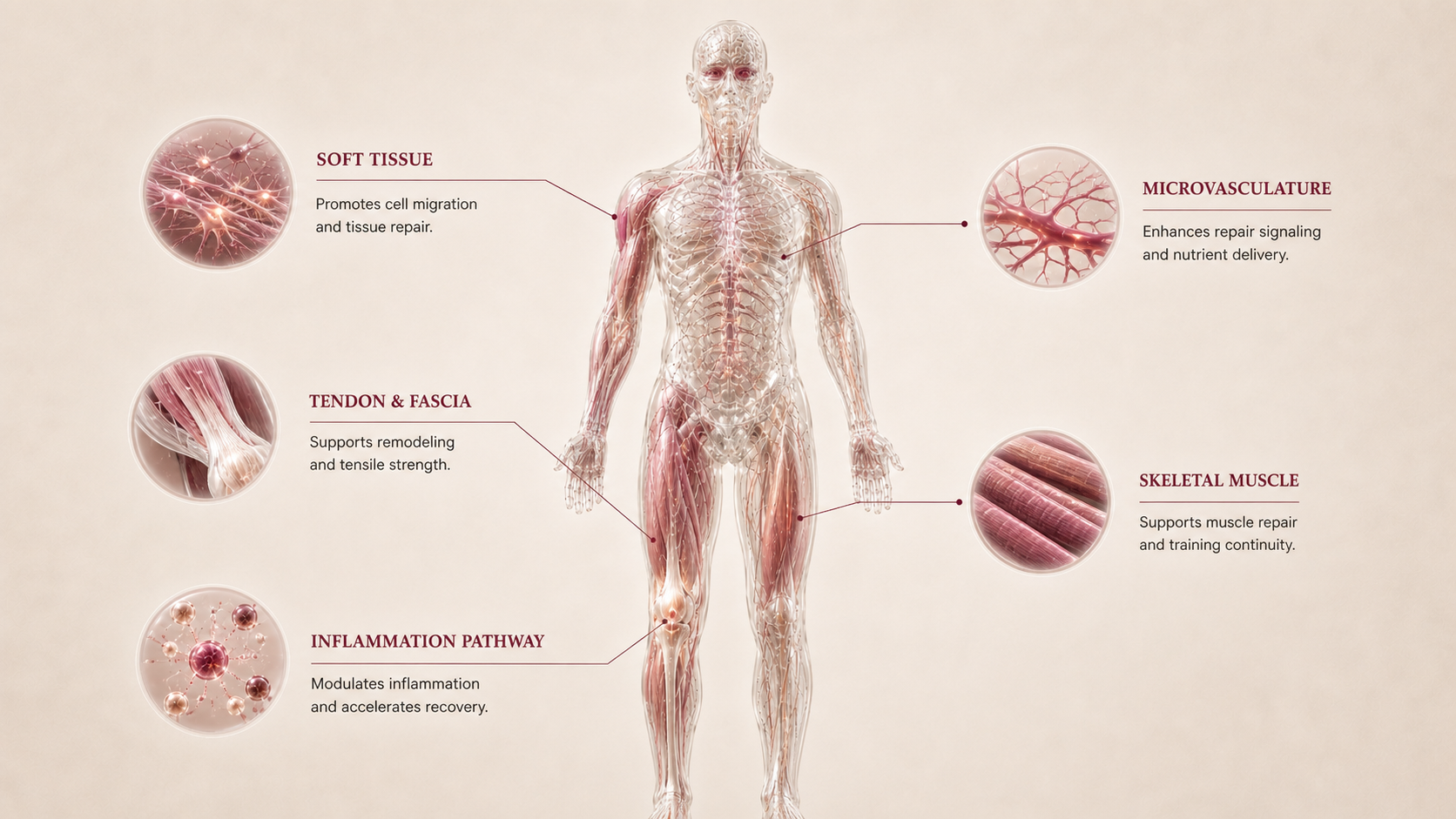
Thymosin beta-4 biology is linked to actin binding, cell migration, angiogenesis, inflammation control, and tissue-repair cascades. TB-500 is usually discussed as a fragment-related product, so the mechanism must be read with identity caution.
| Pathway | Practical effect |
|---|---|
| Cell migration | Thymosin beta-4 literature supports movement of repair-relevant cells. |
| Tissue remodeling | Dermal, ocular, cardiac, and soft-tissue contexts inform the category. |
| Systemic framing | Often discussed when recovery is broader than one local site. |
| Identity check | Evidence for full-length thymosin beta-4 cannot be assumed for every TB-500 product. |
TB-500 helps explain the broad recovery lane, but identity and evidence limits decide how seriously to read a claim.
What the evidence shows
TB-500 has three evidence layers: mechanistic evidence is moderate for thymosin beta-4 biology; human outcome evidence is low for TB-500 fragment recovery; regulatory/label evidence is absent for recovery and anti-doping context matters.
| Study | Population | Key result | How to read it |
|---|---|---|---|
| Mechanistic evidence | Thymosin beta-4 biology | Supports cell migration, actin binding, wound-repair cascades, and tissue-remodeling concepts | Moderate mechanism grounding, not direct TB-500 proof. |
| Human outcome evidence | Fragment-specific recovery context | Direct human musculoskeletal recovery evidence for TB-500 fragment products is limited | Low for consumer recovery claims. |
| Regulatory / label evidence | FDA safety-risk / withdrawn nomination context plus sport-rule review | TB-500 fragment is listed with immunogenicity and lack-of-human-exposure concerns | No approved recovery label; anti-doping sensitivity must be visible. |
- Direct human musculoskeletal recovery evidence for TB-500 fragment products is limited.
- Product identity can be unclear in the market.
- Combination evidence with BPC-157 is not established.
- Sport-rule implications can change practical relevance.
Safety, side effects, and contraindications
- Local irritation or nonspecific symptoms may be reported in research-use contexts.
- Attribution is difficult when paired with BPC-157.
- Quality and identity uncertainty are central risks.
- FDA safety-risk concerns for thymosin beta-4 fragment products.
- Anti-doping rules may apply to thymosin beta-4 derivatives.
- Cancer, active infection, surgery, pregnancy, and unexplained injury need professional review.
- Competitive sport without anti-doping review.
- Active malignancy or unresolved oncology history without clinician review.
- Active infection, open wound complication, or recent surgery without clinical direction.
- Pregnancy or lactation without professional review.
- Acute trauma with severe pain, inability to bear weight, suspected rupture, deformity, fever, heat, redness, discharge, neurologic symptoms, progressive night pain, suspected fracture, post-operative worsening, or unexplained worsening despite rest.
For Ana, TB-500 should not be treated as the next automatic layer after BPC-157; the knee issue still needs a readable rehab and attribution plan.
Reference protocol
Variable clinical context: TB-500 is anchored to thymosin beta-4 and fragment research plus FDA safety-risk compounding framing, not to an approved soft-tissue recovery label.
- Full-length thymosin beta-4 treated as identical to TB-500 fragment products
- BPC-157 plus TB-500 blends
- Loading/maintenance community charts
- Vendor naming used as identity proof
- Research-only or grey-market products treated as medication
| Item | Reference |
|---|---|
| Reference | Research-sensitive fragment identity context; not an approved human recovery protocol. |
| Route/frequency | No official recovery schedule is published in this report. |
| Application footprint | Cannot be inferred from community loading language or vendor blends. |
| Decision frame | Identity, sport rules, injury pattern, rehab status, and attribution clarity. |
- Clarify whether a source discusses full-length thymosin beta-4, TB-500, or a related fragment.
- Do not transfer evidence between forms without checking the studied compound.
- Interpret TB-500 as broader remodeling/systemic recovery discussion, not as guaranteed local tissue repair.
- For chronic tendon issues, rehab loading still drives the outcome interpretation.
- Avoid starting with blends if the goal is to know which component matters.
- Watch for training-load changes that could explain improvement or relapse.
- Tested athletes need anti-doping review before considering any thymosin beta-4 derivative discussion.
- Regulatory and product-quality review belongs before any practical interpretation.
| Item | Reference |
|---|---|
| Source anchor | Thymosin beta-4 biology, fragment-identity caution, FDA safety-risk context, and WADA review for athletes. |
| Protocol status | No official recovery schedule or application count in this report. |
| Main dependency | Identity, sport rules, injury diagnosis, rehab, and attribution clarity. |
| Blend boundary | BPC-157 plus TB-500 appears in overlap education, not as a peptide card. |
- Is the claim about TB-500, thymosin beta-4, or a fragment?
- Is the user subject to anti-doping rules?
- Is the target a chronic systemic recovery pattern or a specific injury diagnosis?
- Can response be attributed if BPC-157 or a blend is used at the same time?
- Is the source regulated, research-only, compounded, or grey-market?
- Whether the recovery question is local tendon pain, systemic training recovery, or soft-tissue remodeling.
- The level of sport-rule review needed for tested athletes.
- How clinicians weigh animal, ocular, dermal, and fragment literature.
- Identity distinction between full-length thymosin beta-4 and TB-500 fragment products.
- FDA safety-risk concerns around immunogenicity, peptide-related impurities, and lack of human exposure data for the fragment.
- Anti-doping status for competitive athletes.
- Treating loading/maintenance community language as an official protocol.
- Using blends when causality matters.
TB-500 administration language is especially vulnerable to community-protocol drift. This dossier avoids translating fragment research into application instructions.
- Verify identity before interpreting mechanism or evidence.
- Do not use vendor shorthand as proof that the product matches a studied molecule.
- Avoid blending with BPC-157 when evaluating response clarity.
- Tested athletes need sport-rule review before any practical discussion.
The maintenance question is whether function and rehab capacity improve, not whether a community loading phase was completed.
- Keep progressive loading and symptom tracking as the reference frame.
- If multiple compounds are layered, attribution becomes weak.
- If the target is chronic pain without diagnosis, reassess before adding mechanisms.
| Question | Reference answer |
|---|---|
| Is TB-500 the same as thymosin beta-4? | Not necessarily. Many sources blur full-length thymosin beta-4, TB-500, and fragments. Identity must be clarified first. |
| Does Peptivius publish a loading phase? | No. Community loading and maintenance language is not treated as an official recovery protocol. |
| Why does sport status matter? | Thymosin beta-4 derivatives appear in anti-doping contexts, so tested athletes need rule review. |
| Why not combine it immediately with BPC-157? | A combination can reduce clarity about which compound helped or caused a problem. |
Educational reference only. TB-500 community loading language is not adopted as a protocol.
- Do not assume every TB-500 product matches full-length thymosin beta-4 evidence.
- Do not read loading/maintenance forum language as official guidance.
- Do not combine first and ask attribution later.
- Do not ignore anti-doping context for tested athletes.
Monitoring and labs
- Clarify diagnosis, injury type, injury age, location, imaging status, rehab plan, and current load-management strategy.
- Record pain at rest, pain during load, pain 24 hours after training, range of motion, strength, swelling, and training tolerance.
- Document return-to-run, return-to-squat, or return-to-sport markers when relevant.
- Record sleep impact, protein/nutrition context, rehab adherence, and medication changes.
- Review medications, procedures, autoimmune history, cancer history, pregnancy context, and tested-sport status.
- Track function, pain at rest, pain under load, next-day pain, training load, swelling, local irritation, systemic symptoms, and whether rehab tolerance actually improves.
- Separate normal loading adaptation from a peptide-attributed effect.
- Pause interpretation if multiple new compounds or blends were introduced together.
- Escalate medical review if new red-flag symptoms appear.
- Keep progressive loading, sleep, protein adequacy, and recurrence prevention as the foundation.
- Reassess if pain returns, function stalls, or the compound becomes a substitute for diagnosis or rehab.
- Use functional milestones rather than calendar promises to judge return-to-run, return-to-squat, or return-to-sport readiness.
- Treat stopping as an interpretation checkpoint, not as a universal taper.
For TB-500, monitoring must include identity clarity and sport-rule context in addition to functional recovery tracking.
Regulatory status & study stage
TB-500 is a research-sensitive recovery compound with fragment-identity and anti-doping implications. It is not an approved broad recovery therapy.
| Item | Status | How to read it |
|---|---|---|
| FDA label | No general recovery approval | No human soft-tissue recovery label is used as an anchor. |
| FDA safety-risk page | Compounding concern | Thymosin beta-4 fragment, also known as TB-500, is listed with immunogenicity and human-exposure concerns. |
| Anti-doping | Sport-rule sensitive | WADA materials name thymosin beta-4 derivatives such as TB-500 in prohibited-list context. |
- Thymosin beta-4 biology has meaningful repair literature.
- TB-500 fragment-specific human recovery evidence is less mature.
- Identity and regulation are part of the evidence interpretation.
- Research-only products should not be treated as equivalent to studied or approved medication.
- Blends add quality and attribution risk.
- Anti-doping context may make practical use inappropriate for tested athletes.
The dossier intentionally separates mechanism interest from product equivalence.
Stacking and synergies
TB-500 is commonly discussed with BPC-157, but that combination belongs in the niche overlap map, not as a personal stack recommendation.
- Rehab, progressive load, sleep, and nutrition remain the cleanest support foundation.
- BPC-157 pairing can be discussed conceptually in the final map.
- Identity verification is a prerequisite before any combination interpretation.
- TB-500 plus unknown thymosin fragments.
- TB-500 inside all-in-one blends with no component clarity.
- Multiple repair peptides added before the injury driver is clear.
- Tested athletes.
- Surgery, active infection, malignancy history, pregnancy, or severe injury.
- Any multi-peptide blend decision.
Do not turn broader recovery biology into an automatic stack with BPC-157.
Genetic variable
No validated consumer genetic marker predicts TB-500 response. Cell migration, collagen, inflammation, and angiogenesis genes may shape recovery biology generally, but not TB-500 selection.
- No validated TB-500 response genotype.
- Recovery and remodeling genetics may contextualize injury risk.
- Fragment-specific response prediction is not ready.
Use genetics as background recovery context, not as a peptide selector.
Real-world reports
- Frequently discussed with BPC-157 for tendon, ligament, and training recovery.
- Users often describe systemic recovery or mobility themes.
- Vendor naming confusion appears often.
- Anti-doping concerns.
- Unclear fragment identity.
- No clean attribution inside a blend.
- Limited human evidence.
- Community use explains why TB-500 belongs in the map.
- It does not establish a clinical protocol.
- Identity clarity is the first filter.
Final personalized interpretation
For Ana, TB-500 is a strong secondary Recovery option because chronic tendinopathy can invite broader remodeling questions after the localized lead candidate is understood.
It stays below BPC-157 because the injury is concrete and local. TB-500 adds more uncertainty around identity, sport rules, product quality, and attribution.
The practical reading is to understand the broader recovery lane, not to turn BPC-157 plus TB-500 into an automatic stack.
For Ana, TB-500 is useful recovery literacy and a professional-review topic, not a blend instruction.