SS-31 / Elamipretide
An adjacent mitochondrial recovery comparator anchored to elamipretide/Forzinity, not a general injury-repair peptide.
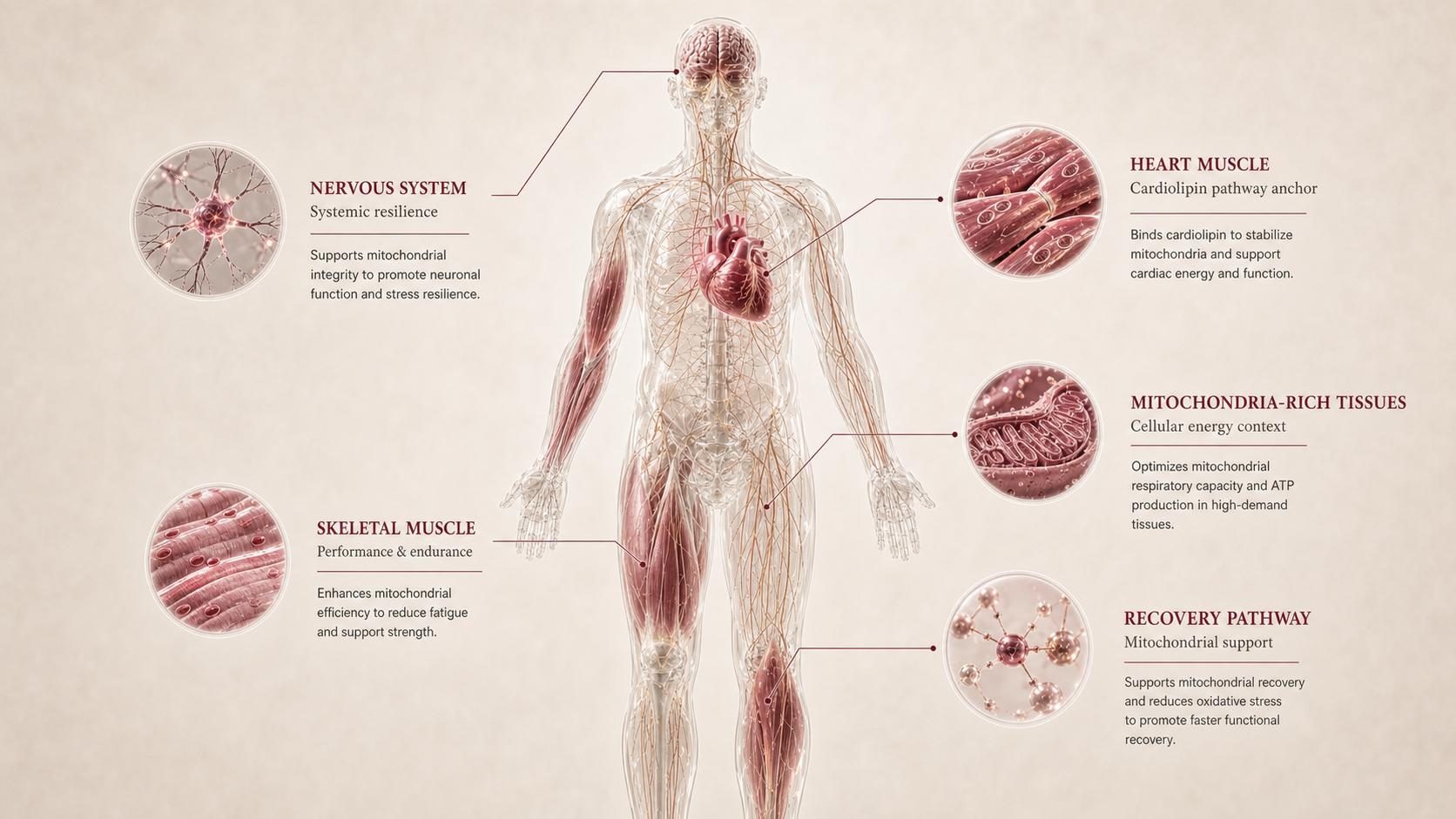
Mitochondrial cardiolipin-binding tetrapeptide known as SS-31, elamipretide, MTP-131, and Forzinity in the approved product context.
SS-31 is included because recovery is sometimes limited by systemic fatigue and mitochondrial context, not only tendon tissue. Its anchor is narrow: Forzinity is approved for Barth syndrome muscle-strength improvement. That approval should not be generalized into sports recovery, injury healing, or longevity.
Why it may make sense for you
For Ana, SS-31 sits last because the Recovery & Healing problem is primarily tendon-related. It remains useful as a comparator for systemic fatigue and mitochondrial context, especially when fatigue is confused with tissue repair. Data confidence is Medium: the tendon signal is clear enough to deprioritize SS-31, but fatigue workup, diagnosis, imaging, functional scoring, and rehab history would sharpen the boundary.
| Signal | Interpretation |
|---|---|
| Recovery signal | Adjacent systemic fatigue / mitochondrial context |
| Best role | Comparator, not primary tendon repair |
| Data confidence | Medium - localized tendon signal is clear, but fatigue workup, diagnosis detail, imaging, functional scale, and rehab history remain incomplete. |
| Regulatory anchor | Forzinity label for Barth syndrome muscle strength |
| Main caution | Rare-disease approval is not broad recovery approval |
- Most regulated anchor in this Recovery set, but in a narrow indication.
- Useful for explaining mitochondrial recovery separately from repair peptides.
- Can prompt broader fatigue workup thinking.
- Not a classic tendon or wound-healing peptide.
- Not a reason to build a repair stack.
- Research-only products are not label-equivalent.
How it works
Elamipretide is described in the FDA label as a mitochondrial cardiolipin binder. In Recovery & Healing, that mechanism is adjacent to cellular energy and systemic fatigue interpretation. It does not establish direct tendon, ligament, wound, or cartilage repair.
| Pathway | Practical effect |
|---|---|
| Mitochondrial membrane | Cardiolipin-binding context anchors the mechanism. |
| Muscle strength label | Forzinity is approved for Barth syndrome muscle-strength improvement. |
| Fatigue context | May help frame systemic recovery questions, not local injury repair. |
| Boundary | Rare-disease label does not generalize to athletic recovery. |
SS-31 belongs in Recovery as the mitochondrial comparator, not as a healing-stack ingredient.
What the evidence shows
SS-31 has three evidence layers: mechanistic evidence is mitochondrial/cardiolipin biology; human outcome evidence is label-specific for Barth syndrome muscle strength; Recovery & Healing outcome evidence is low and adjacent outside that indication.
| Study | Population | Key result | How to read it |
|---|---|---|---|
| Mechanistic evidence | Mitochondrial cardiolipin biology | Forzinity label describes elamipretide as a mitochondrial cardiolipin binder | Mechanistically relevant to energy biology, not direct tissue repair. |
| Human outcome evidence | Barth syndrome label-specific context | Indicated to improve muscle strength under accelerated approval in eligible Barth syndrome patients | Human evidence is real but narrow and not general Recovery evidence. |
| Regulatory / label evidence | FDA-approved Forzinity label | Approval is limited to Barth syndrome muscle-strength improvement and is not broad injury, sports, wound, or longevity approval | Use as an adjacent comparator only. |
- General athletic recovery, tendon healing, and wound-healing translation are not established.
- Research-only SS-31 is not equivalent to Forzinity.
- Long-term broad-use safety outside the label is not defined here.
- Mitochondrial benefit claims require diagnosis and clinical context.
Safety, side effects, and contraindications
- Injection-site reactions are prominent in the approved-label safety context.
- Hypersensitivity reactions require attention in label context.
- Research-only products add identity and quality risk.
- Forzinity label includes hypersensitivity warnings and renal-impairment considerations.
- Rare-disease labeling should not be translated into sports recovery or longevity instructions.
- Nonspecific fatigue needs broader medical evaluation.
- Serious hypersensitivity to elamipretide or product excipients.
- Renal impairment context without clinician review.
- Pregnancy or lactation without professional review.
- Use in neonates or pediatric contexts outside label-specific professional care.
- Research-only SS-31 treated as approved Forzinity.
- Unexplained severe fatigue, progressive night pain, neurologic symptoms, suspected fracture, cancer history with new bone pain, or worsening injury symptoms without medical evaluation.
For Ana, SS-31 is not a direct answer to patellar tendinopathy; it is a mitochondrial comparator that should not distract from injury rehab.
Reference protocol
Adjacent indication anchor: Forzinity/elamipretide labeling for Barth syndrome muscle-strength improvement is the anchor. It is not a broad sports recovery, injury, or fatigue label.
- SS-31 sold as a general recovery peptide
- Research-only elamipretide or MTP-131 products
- Sports fatigue or longevity protocols
- BPC-157, TB-500, GHK-Cu, or KPV repair mechanisms
- Rare-disease label translated into a consumer recovery plan
| Item | Reference |
|---|---|
| Reference | FDA-approved Forzinity context for Barth syndrome muscle strength; adjacent to Recovery, not a general healing label. |
| Route/frequency | Product-specific label instructions exist, but this report does not convert them into a recovery protocol. |
| Application footprint | Defined by the approved product and rare-disease care context, not by sports recovery goals. |
| Decision frame | Mitochondrial disease context, renal status, hypersensitivity, injection-site reactions, and indication mismatch. |
- Read SS-31 through the Barth syndrome label first.
- Do not treat approval in a rare disease as approval for tendon, ligament, surgery, athletic recovery, or longevity.
- The mechanism is adjacent to energy and mitochondrial biology, not local tissue repair.
- Fatigue or poor recovery needs broader evaluation before being interpreted as an SS-31 fit.
- Label context includes hypersensitivity, local administration reactions, renal impairment considerations, and product-specific handling.
- Research-only or grey-market products are not label-equivalent.
- Use SS-31 as an adjacent comparator in Recovery & Healing, not as a front-line injury peptide.
- If the problem is tendon pain, BPC-157/TB-500-style discussions are more directly relevant, while rehab remains central.
| Item | Reference |
|---|---|
| Source anchor | FDA Forzinity/elamipretide label for Barth syndrome muscle-strength improvement. |
| Protocol status | Product-specific label exists, but Peptivius does not translate it into consumer recovery instructions. |
| Main dependency | Indication boundary, renal status, hypersensitivity, product identity, and clinician review. |
| Recovery boundary | Mitochondrial context is adjacent, not direct tissue-repair evidence. |
- Is the user reading the FDA label or a general online recovery claim?
- Is there a mitochondrial disease context or only nonspecific fatigue?
- Are renal impairment, hypersensitivity, pregnancy/lactation, or pediatric/neonate issues relevant?
- Is the product Forzinity or a research-only product using SS-31 language?
- Would injury diagnosis, rehab, sleep, nutrition, or endocrine review better explain recovery limitation?
- Whether SS-31 is discussed as rare-disease medication, mitochondrial research, or adjacent recovery comparator.
- Monitoring emphasis based on renal status, hypersensitivity history, and fatigue workup.
- How much relevance is assigned when the recovery goal is systemic fatigue rather than local injury.
- The Forzinity indication boundary for Barth syndrome muscle strength.
- Product-specific label handling and safety review.
- Hypersensitivity, renal impairment, neonate/pediatric, pregnancy/lactation, and rare-disease care context.
- Treating research-only SS-31 as approved Forzinity.
- Using mitochondrial language as proof of broad athletic recovery benefit.
SS-31 administration literacy starts with the Forzinity label. The Blueprint does not translate a rare-disease label into consumer recovery instructions.
- Confirm whether the reference is Forzinity or a research-only SS-31/elamipretide product.
- Do not reuse label handling language for non-label products.
- Rare-disease approval does not imply broad injury, fatigue, or longevity use.
- Any use outside the label needs professional review and cannot be derived from this report.
In this niche, SS-31 is a comparator for systemic mitochondrial context, not the maintenance plan for tissue repair.
- If fatigue is the main issue, evaluate sleep, thyroid, iron, nutrition, training load, medication effects, and inflammation.
- If injury is the main issue, keep rehab and diagnosis central.
- Do not stack SS-31 with repair peptides simply because energy and healing are both recovery words.
| Question | Reference answer |
|---|---|
| Why is SS-31 included? | It helps compare mitochondrial/systemic recovery context against tissue-repair and anti-inflammatory peptides. |
| Is Forzinity approved for general recovery? | No. The FDA label is for Barth syndrome muscle-strength improvement, not broad recovery. |
| Does mitochondrial support repair tendons? | Not automatically. Mitochondrial biology is adjacent, but it is not a direct tendon-healing claim. |
| Can research SS-31 be read like Forzinity? | No. Research-only products are not equivalent to an approved labeled medication. |
Educational reference only. Forzinity label context is not converted into a general recovery protocol.
- Do not read Barth syndrome approval as broad injury-recovery approval.
- Do not treat research-only SS-31 as Forzinity.
- Do not stack with repair peptides to chase energy plus healing.
- Do not use mitochondrial language to skip fatigue workup.
Monitoring and labs
- Clarify diagnosis, injury type, injury age, location, imaging status, rehab plan, and current load-management strategy.
- Record pain at rest, pain during load, pain 24 hours after training, range of motion, strength, swelling, and training tolerance.
- Document return-to-run, return-to-squat, or return-to-sport markers when relevant.
- Record sleep impact, protein/nutrition context, rehab adherence, and medication changes.
- Review medications, procedures, autoimmune history, cancer history, pregnancy context, and tested-sport status.
- Track function, pain at rest, pain under load, next-day pain, training load, swelling, local irritation, systemic symptoms, and whether rehab tolerance actually improves.
- Separate normal loading adaptation from a peptide-attributed effect.
- Pause interpretation if multiple new compounds or blends were introduced together.
- Escalate medical review if new red-flag symptoms appear.
- Keep progressive loading, sleep, protein adequacy, and recurrence prevention as the foundation.
- Reassess if pain returns, function stalls, or the compound becomes a substitute for diagnosis or rehab.
- Use functional milestones rather than calendar promises to judge return-to-run, return-to-squat, or return-to-sport readiness.
- Treat stopping as an interpretation checkpoint, not as a universal taper.
For SS-31, monitoring emphasizes indication boundary, renal context, hypersensitivity, fatigue workup, and separation from injury-repair claims.
Regulatory status & study stage
SS-31 is the only Recovery & Healing entry with a current FDA-approved product anchor, but that anchor is Forzinity for Barth syndrome muscle strength, not broad recovery.
| Item | Status | How to read it |
|---|---|---|
| Forzinity | FDA approved in 2025 | Mitochondrial cardiolipin binder indicated to improve muscle strength in Barth syndrome patients meeting label criteria. |
| Approval pathway | Accelerated approval | Continued approval may depend on confirmatory clinical benefit verification. |
| Recovery role | Adjacent comparator | Useful for mitochondrial context, not tendon or wound-healing claims. |
- Approved in a narrow rare-disease indication.
- General fatigue and recovery use is not established by the label.
- Research-only SS-31 should not be treated as a branded medication.
- A regulated product exists for a narrow indication.
- Non-label recovery claims require professional review and cannot be derived here.
- Grey-market products introduce identity and safety risks.
This dossier uses the label as a boundary, not as a recovery protocol.
Stacking and synergies
SS-31 can appear in advanced recovery stacks, but Peptivius treats it as adjacent mitochondrial education, not a repair-stack ingredient.
- Fatigue workup: sleep, thyroid, iron, nutrition, training load, medications, and inflammation.
- Rehab and loading for local tissue injury.
- Professional review for any non-label mitochondrial therapy discussion.
- SS-31 added to repair peptides because energy and healing sound related.
- Research SS-31 plus approved-product claims.
- Mitochondrial claims used to explain all recovery problems.
- Renal impairment, hypersensitivity history, pregnancy, lactation, pediatric context, or rare-disease context.
- Any use outside Forzinity labeling.
- Any stack with BPC-157, TB-500, GHK-Cu, or KPV.
Do not generalize a rare-disease label into a broad recovery stack.
Genetic variable
SS-31 genetics are not a consumer selection engine. Barth syndrome itself is a genetic disease context, but that does not translate into general recovery response prediction.
- TAZ mutation context matters for Barth syndrome diagnosis, not broad recovery selection.
- Mitochondrial and oxidative-stress genes may frame fatigue biology.
- No consumer SNP should predict SS-31 recovery benefit.
Genetics reinforces the indication boundary rather than expanding it.
Real-world reports
- Users discuss energy, mitochondrial resilience, and fatigue recovery.
- Some conflate Forzinity approval with general SS-31 availability.
- SS-31 is often pulled into longevity or performance narratives.
- Indication mismatch.
- Access and product identity concerns.
- No direct injury-repair claim.
- Need for fatigue workup before peptide interpretation.
- The real-world signal is mostly adjacent recovery interest.
- FDA approval should narrow the claim, not widen it.
- For Ana's knee, SS-31 is lower priority than tissue-repair and rehab-centered options.
Final personalized interpretation
For Ana, SS-31 is useful because it explains why systemic fatigue and mitochondrial context are separate from tendon recovery. That distinction matters in a maximalist peptide report.
It ranks last because Ana's recovery limitation is patellar tendinopathy, where diagnosis, load management, rehab, and tissue-repair literacy are more directly relevant.
The Forzinity label gives SS-31 a stronger regulatory anchor than most recovery peptides, but only in a narrow rare-disease context. That anchor should not be stretched into a general recovery plan.
For Ana, SS-31 is an adjacent comparator, not a current lead Recovery option.