Ipamorelin
Ipamorelin is included in Performance & Muscle as secretagogue comparator for recovery, body composition, and cjc-1295 pairing literacy.
GHSR agonist / GH secretagogue. FDA materials flag immunogenicity, peptide-impurity, unnatural-amino-acid, and insufficient-route-safety concerns for ipamorelin acetate.
Ipamorelin is not framed as a shortcut to strength or hypertrophy. The dossier separates mechanism, human performance evidence, regulatory status, monitoring burden, and Ana's training context.
Why it may make sense for you
For Ana, Ipamorelin ranks #2 because Ana's lean-mass preservation concern and training volume make the CJC/ipamorelin conversation worth explaining. The common pairing is not a recommendation, and endocrine monitoring burden is high. Data confidence is Medium: the profile gives a strong training-context read, but performance labs, injury imaging, sleep metrics, and training logs would sharpen the ranking.
| Signal | Interpretation |
|---|---|
| Training context | CrossFit/HIIT, advanced training, recomposition, and lean-mass preservation concern. |
| Category fit | Secretagogue comparator for recovery, body composition, and CJC-1295 pairing literacy. |
| Data confidence | Medium - good BioProfile signal, but training logs, sleep data, labs, and injury workup are incomplete. |
| Main caution | Often appears inside CJC stacks, which can obscure attribution and turn education into protocol thinking. |
- Advanced training makes performance context relevant.
- Recomposition and lean-mass preservation are explicit concerns.
- The compound clarifies one major mechanism family inside the niche.
- Chronic knee limitation may be the real performance bottleneck.
- PCOS/metformin, stress, sleep, and anti-doping context can change interpretation.
- The report does not turn rank into action.
How it works
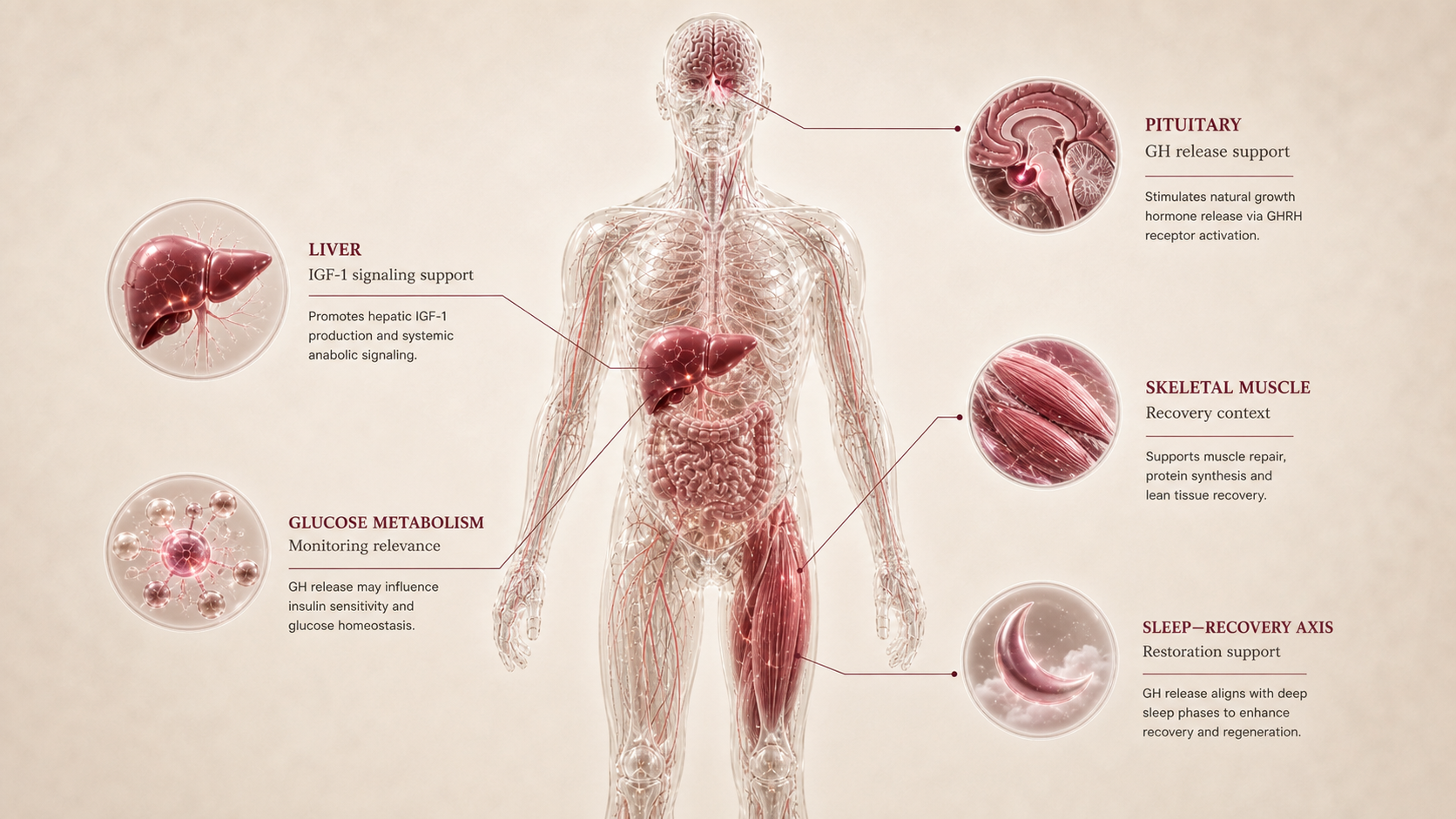
Ipamorelin is discussed as a GH secretagogue acting through GHSR/ghrelin-family signaling. The performance conversation centers on endogenous GH release, recovery perception, sleep-linked adaptation, and body-composition interpretation.
| Pathway | Practical effect |
|---|---|
| Input | GHSR agonist / GH secretagogue. |
| Performance lens | Secretagogue comparator for recovery, body composition, and CJC-1295 pairing literacy. |
| Interpretation | Mechanism can explain plausibility, but does not prove strength, hypertrophy, endurance, or recovery outcomes. |
Ipamorelin helps explain one performance pathway, but the pathway only matters if training, sleep, nutrition, injury status, and safety context make the signal interpretable.
What the evidence shows
Ipamorelin has three evidence layers: mechanistic evidence, human performance/body-composition evidence, and regulatory or label evidence. Peptivius keeps these separate so mechanism hype does not become a protocol.
| Study | Population | Key result | How to read it |
|---|---|---|---|
| Mechanistic evidence | GHSR agonist / GH secretagogue. | Ipamorelin is discussed as a GH secretagogue acting through GHSR/ghrelin-family signaling. The performance conversation centers on endogenous GH release, recovery perception, sleep-linked adaptation, and body-composition interpretation. | Useful for plausibility, not sufficient for a use plan. |
| Human performance / body-composition evidence | Outcome translation | Human performance and hypertrophy outcomes are not mature enough to treat ipamorelin as an established athletic performance drug. | Limited unless label- or trial-specific evidence says otherwise. |
| Regulatory / label evidence | FDA safety-risk compounding page for ipamorelin acetate and growth hormone secretagogue context. | FDA materials flag immunogenicity, peptide-impurity, unnatural-amino-acid, and insufficient-route-safety concerns for ipamorelin acetate. | Defines boundaries and safety framing. |
- Direct human performance outcomes are limited for many compounds in this niche.
- Combination evidence is weaker than component evidence.
- Long-term safety, anti-doping status, and product identity may dominate practical interpretation.
Safety, side effects, and contraindications
- Local irritation or tolerability issues can occur depending on route and product context.
- Sleep, appetite, edema, glucose, mood, or training tolerance may change depending on mechanism family.
- Source quality and product identity are core safety variables for research-sensitive compounds.
- GH-axis compounds require IGF-1, glucose, edema, sleep-apnea, and cancer-history awareness.
- Neuropeptide compounds require mood, anxiety, sleep, blood pressure, and medication-context awareness.
- Recovery compounds require diagnosis, rehab, and injury red-flag review before interpretation.
- Tested athletes need anti-doping review before considering any performance compound.
- Active malignancy or unresolved cancer history without professional review.
- Uncontrolled diabetes, hypoglycemia risk, uncontrolled hypertension, severe sleep apnea, or acute critical illness context.
- Unexplained chest pain, syncope, shortness of breath, sudden performance collapse, or acute injury without diagnosis.
- Adolescents or people still growing outside specialist medical care.
For Ana, the main caution with Ipamorelin is that knee pain, PCOS/metformin, anxiety, sleep stress, and lean-mass goals create several possible performance bottlenecks. A peptide should not obscure the root cause.
Reference protocol
Research-sensitive secretagogue context: FDA safety-risk compounding page for ipamorelin acetate and growth hormone secretagogue context.. This is educational category context, not a consumer protocol or personalized plan.
- A personal training, dosing, timing, or cycle recommendation.
- A community protocol, blend chart, or vendor stack.
- A vial, syringe, units, mL, reconstitution, or dilution instruction.
- An anti-doping clearance for tested athletes.
- A replacement for training, nutrition, sleep, rehab, diagnosis, or clinician review.
| Item | Reference |
|---|---|
| Reference | FDA safety-risk compounding page for ipamorelin acetate and growth hormone secretagogue context. |
| Role | Secretagogue comparator for recovery, body composition, and CJC-1295 pairing literacy. |
| Evidence frame | Selective GH-secretagogue biology with limited direct performance outcomes and FDA safety-risk compounding concerns. |
| Application footprint | Not standardized here; the report does not publish dosing, timing, cycle, or application instructions. |
| Decision points | Training foundation, sleep, protein/calories, injury status, glucose/IGF-1 or neuro/sport context, medication review, and anti-doping status. |
- Confirm training structure, progressive overload, recovery windows, sleep, calories, and protein before interpreting peptides.
- Rule out injury, overtraining, endocrine, glucose, cardiovascular, sleep-apnea, and medication drivers.
- Read Ipamorelin through its mechanism family: GHSR agonist / GH secretagogue.
- Separate direct performance evidence from mechanism, community use, and regulatory status.
- Use function, training tolerance, recovery quality, sleep, adverse symptoms, and labs when relevant as interpretation anchors.
- Do not introduce multiple compounds or blends when attribution matters.
- Defer if red flags, anti-doping exposure, unresolved injury, or medical context make interpretation unsafe.
- Stopping is an interpretation checkpoint, not a universal taper.
| Item | Reference |
|---|---|
| Reference mode | Research-sensitive secretagogue context |
| Primary anchor | FDA safety-risk compounding page for ipamorelin acetate and growth hormone secretagogue context. |
| Not included | No dose, timing, duration, cycle, vial, syringe, unit, mL, dilution, supplier, or stack instruction. |
- Is the bottleneck training design, recovery, nutrition, sleep, injury, endocrine context, or cognition?
- Would this compound add clarity, or would it make attribution harder?
- Are glucose, IGF-1, edema, sleep apnea, cancer history, anxiety, medication, or anti-doping constraints relevant?
- Is the evidence being read as mechanism, human outcome, or regulatory/label evidence?
- Whether the peptide is used as a primary candidate, comparator, or boundary marker inside the niche.
- Which monitoring lens matters most: GH/IGF-1, glucose, injury function, sleep, cognition, or sport rules.
- How much weight the reader gives to mechanism versus human outcomes.
- No conversion into doses, vial math, syringe units, or cycle timing.
- No stack recommendation or DIY blend recreation.
- No assumption that research-only, compounded, or grey-market material equals an approved product.
- No use to bypass diagnosis, rehab, sleep correction, nutrition, or professional review.
Administration is deliberately not operationalized in this report. Product, route, legal status, sport status, and professional oversight decide whether administration should even be discussed.
- Do not infer a route or schedule from community use.
- Do not treat intranasal, subcutaneous, compounded, research-only, and branded products as interchangeable.
- If a label exists, read it only inside that label's indication and presentation.
Performance maintenance is not a peptide phase. It is training continuity, sleep, nutrition, load management, labs when relevant, and honest attribution.
- Use functional performance markers, not calendar promises.
- Reassess if the compound becomes a substitute for training design or recovery correction.
- Avoid adding a second mechanism just because progress is slow.
| Question | Reference answer |
|---|---|
| Is this a protocol? | No. This is use-context literacy, not dosing, timing, cycle, or stack instruction. |
| Can it replace training foundations? | No. Training, protein/calories, sleep, recovery, and rehab are the base layer. |
| Does Match Score apply to stacks? | No. Slice 1 ranks individual peptides only. |
| What if I am tested? | Anti-doping status must be reviewed before any GH-axis, growth-factor, or performance compound discussion. |
Ipamorelin has no Peptivius protocol in this report. The reference block is deliberately limited to education, evidence boundaries, and decision checkpoints.
- Do not recreate community stacks.
- Do not treat research-only products as approved medications.
- Do not ignore injury, sleep, nutrition, glucose, endocrine, or anti-doping constraints.
Monitoring and labs
- Clarify training program, performance bottleneck, injury status, sleep, calories, protein, and recovery windows.
- Review medications, PCOS/glucose context, thyroid status, anxiety/sleep context, cancer history, and sport/testing status.
- For GH-axis compounds, consider IGF-1, fasting glucose/HbA1c, edema, sleep apnea, and endocrine review.
- Track training output, soreness, pain under load, next-day recovery, sleep quality, appetite, mood, and adverse symptoms.
- Do not interpret changes if multiple new compounds, supplements, or training changes started together.
- Escalate medical review if red flags or unexpected symptoms appear.
- Keep training structure, protein/calorie adequacy, sleep, and rehab as the measurable foundation.
- Use performance markers and function, not calendar promises, to judge whether the path is working.
- Treat stopping as a clarity checkpoint, not a universal taper.
Performance monitoring starts with training and recovery data. Labs matter most when the mechanism intersects GH/IGF-1, glucose, endocrine, or medication context.
Regulatory status & study stage
FDA materials flag immunogenicity, peptide-impurity, unnatural-amino-acid, and insufficient-route-safety concerns for ipamorelin acetate.
| Item | Status | How to read it |
|---|---|---|
| Status | Research Only | Read only inside the stated indication or research context. |
| Evidence maturity | Selective GH-secretagogue biology with limited direct performance outcomes and FDA safety-risk compounding concerns. | Mechanism, human outcomes, and label status are separate. |
| Sports context | Anti-doping-sensitive | Tested athletes need professional rule review. |
- Human performance and hypertrophy outcomes are not mature enough to treat ipamorelin as an established athletic performance drug.
- Performance outcomes should not be inferred from community use or blend marketing.
- Low/moderate; route, product identity, glucose, edema, IGF-1, and sport-rule context decide readiness.
- Source quality and product identity can dominate safety interpretation.
This dossier does not convert label, trial, or research context into consumer instructions.
Stacking and synergies
Ipamorelin may appear in stacks or blends, but Peptivius keeps stack literacy at the niche level. This dossier evaluates the individual peptide.
- Training, protein adequacy, sleep, and load management.
- Rehab and diagnosis when pain limits training.
- Clinician-reviewed lab monitoring when endocrine or glucose context exists.
- Multiple GH-axis compounds layered without a clear reason.
- Nootropic stacking when sleep debt or anxiety is the real bottleneck.
- Recovery blends when injury diagnosis is unclear.
- Any GH/IGF-1 overlap.
- Any tested-athlete context.
- Any cancer history, glucose disorder, cardiovascular red flag, or unexplained injury pattern.
More mechanisms do not automatically mean better performance. Layering compounds can reduce clarity and increase monitoring burden.
Genetic variable
Ipamorelin has no validated consumer genetic response engine in Peptivius today. The genes below are pathway literacy only.
- No validated consumer genotype determines this peptide response.
- Pathway genes may explain why GH, glucose, stress, or recovery responses vary.
- No SNP should turn a performance peptide into a treatment recommendation.
Future DNA layers may improve interpretation, but this Slice 1 report does not personalize performance peptides from genotype.
Real-world reports
- Users often discuss performance peptides as stacks, but stack anecdotes are weak evidence.
- Reported benefits often overlap with training, sleep, calorie changes, and placebo effects.
- Source quality and product identity are recurring concerns.
- Unclear benefit attribution.
- Sleep, appetite, glucose, edema, anxiety, or injection-route concerns.
- Anti-doping or professional oversight concerns.
- Anecdotes can show what users worry about, but not what reliably works.
- The strongest read comes from measured training, recovery, labs, and symptom context.
- Blend marketing should be decomposed into component mechanisms.
Final personalized interpretation
For Ana, Ipamorelin is not a simple muscle-building answer. The profile combines CrossFit/HIIT, advanced training, body recomposition, lean-mass concern, chronic knee limitation, PCOS/metabolic context, anxiety, stress, and limited sleep.
That means the best interpretation is bottleneck-first: decide whether the limiting factor is training design, sleep, nutrition, injury, endocrine/metabolic context, cognition, or recovery before giving any peptide too much credit.
Ipamorelin is useful in the report because it explains one part of that map. It does not replace coaching, rehab, sleep correction, labs, or professional review.
For Ana, Ipamorelin should be read as Performance & Muscle education, not a use instruction.