GHK-Cu
The collagen, skin, wound-biology, and superficial tissue-quality peptide inside Recovery & Healing.
Copper-binding tripeptide, glycyl-L-histidyl-L-lysine copper complex, studied in skin regeneration, extracellular-matrix remodeling, and wound-biology contexts.
GHK-Cu belongs in Recovery & Healing because not every recovery question is a tendon protocol. It is strongest as collagen, skin, wound, scar, and superficial tissue-quality context, with crossover into Skin & Anti-Aging. The report does not extrapolate that into guaranteed deep tendon or cartilage repair.
Why it may make sense for you
For Ana, GHK-Cu ranks third because it can support the broader tissue-quality conversation, but her primary limitation is a deep training-related tendon issue rather than a skin or procedure-recovery goal. Data confidence is Medium: the match is understandable, but deeper orthopedic detail, imaging, functional scoring, and route/formulation clarity would make the read stronger.
| Signal | Interpretation |
|---|---|
| Recovery signal | Connective-tissue and collagen literacy |
| Best role | Skin, wound, scar, superficial tissue quality |
| Data confidence | Medium - tissue-quality context is clear, but deep-injury diagnosis, imaging, functional scale, rehab history, and route/formulation details remain incomplete. |
| Lower-fit reason | Less direct for chronic patellar tendinopathy |
| Main caution | Route and formulation cannot be blurred |
- Relevant to collagen and tissue-quality education.
- Useful if post-procedure or skin-repair goals are present.
- Does not need to be framed as an appetite or hormone peptide.
- Deep tendon claims require restraint.
- Formulation quality and route drive interpretation.
- May distract from rehab if treated as an injury fix.
How it works
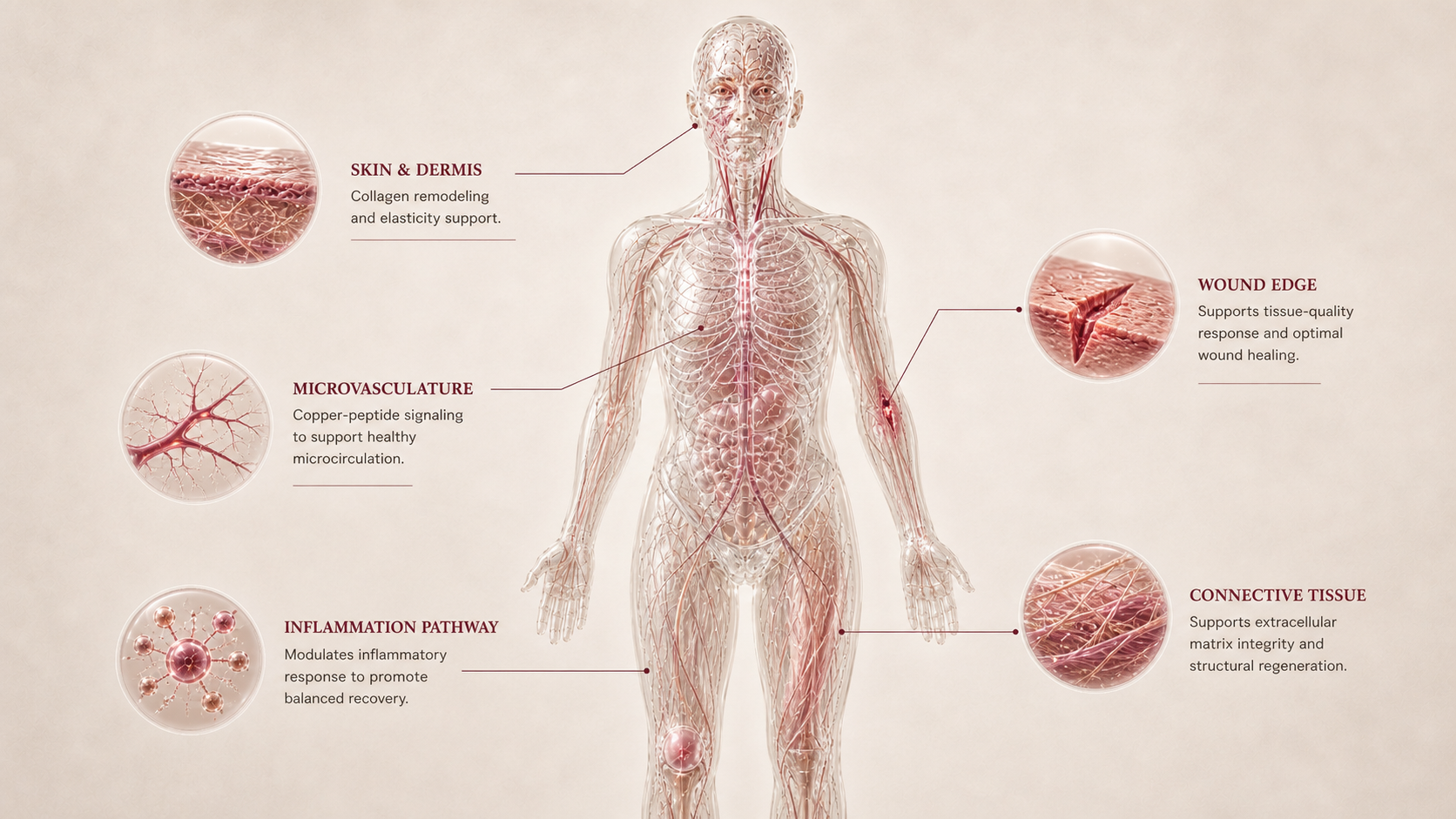
GHK-Cu is a small copper-binding peptide discussed in extracellular-matrix remodeling, collagen and glycosaminoglycan biology, fibroblast function, and skin/wound repair. The strongest reading is tissue quality and superficial repair, not universal structural regeneration.
| Pathway | Practical effect |
|---|---|
| Copper binding | Supports the identity of the GHK-Cu complex and formulation-specific interpretation. |
| Dermal fibroblasts | Research links GHK-Cu to collagen and extracellular-matrix remodeling. |
| Wound biology | Skin and wound-healing contexts explain Recovery relevance. |
| Route boundary | Topical/cosmetic and injectable/systemic claims must be separated. |
GHK-Cu is a tissue-quality and skin/wound peptide in this map, not a proven deep tendon repair shortcut.
What the evidence shows
GHK-Cu has three evidence layers: mechanistic evidence is moderate for collagen, skin, extracellular-matrix, fibroblast, and wound biology; human outcome evidence is limited and stronger for topical/skin context than deep injury; regulatory/label evidence depends on route and formulation.
| Study | Population | Key result | How to read it |
|---|---|---|---|
| Mechanistic evidence | Copper-peptide collagen and wound biology | Describes extracellular-matrix, fibroblast, collagen, dermal repair, and gene-expression context | Moderate for skin/wound mechanism; not deep-injury proof. |
| Human outcome evidence | Topical/skin and wound-adjacent context | Translation is stronger for superficial tissue quality than tendon, cartilage, or deep musculoskeletal injury | Limited for deep-injury recovery. |
| Regulatory / label evidence | Route-specific FDA safety-risk / withdrawn nomination context | Injectable GHK-Cu has separate FDA safety-risk framing from topical/cosmetic contexts | Route and formulation decide how claims should be read. |
- Deep tendon, cartilage, and joint-repair translation is not established.
- Formulation quality, route, and concentration claims are market-sensitive.
- Injectable safety and compounding status require separate review.
- Combination claims with BPC-157, TB-500, or KPV are not the same as GHK-Cu evidence.
Safety, side effects, and contraindications
- Topical irritation or skin sensitivity can occur depending on formulation.
- Product instability or unclear ingredient identity can undermine interpretation.
- Local reaction patterns can be confused with intended remodeling.
- Injectable-route safety concerns differ from topical/cosmetic use.
- Open wounds, procedures, infection, pregnancy, and allergy history need professional direction.
- Copper-related or dermatologic sensitivity should be reviewed in context.
- Open or infected wound without clinician direction.
- Recent procedure without following the treating professional's instructions.
- Known sensitivity to formulation ingredients.
- Pregnancy or lactation without professional review.
- Injectable-route use treated as cosmetic topical context.
- Open wound with infection signs, fever, heat, redness, discharge, post-procedure worsening, suspected deeper injury, or unexplained worsening despite rest.
For Ana, GHK-Cu is relevant as tissue-quality education, but it should not be mistaken for the primary answer to chronic patellar tendinopathy.
Reference protocol
Variable clinical context: GHK-Cu is anchored to copper-peptide skin, collagen, and wound-biology literature plus route-specific FDA compounding context.
- Injectable GHK-Cu treated as equivalent to topical or cosmetic use
- Deep tendon or cartilage repair inferred from skin biology
- GHK-Cu inside multi-peptide healing blends
- Copper supplements or unrelated copper products
- Research products treated as standardized medication
| Item | Reference |
|---|---|
| Reference | Skin, collagen, extracellular-matrix, and wound-biology context; not a universal deep-injury label. |
| Route/formulation | Route matters; topical, cosmetic, research, and injectable contexts are not interchangeable. |
| Application footprint | Not standardized here because formulation and route change interpretation. |
| Decision frame | Superficial tissue quality, skin recovery, procedure context, irritation risk, and formulation credibility. |
- Separate skin/collagen/wound-healing biology from deep tendon, cartilage, or joint claims.
- Clarify whether the discussion is topical, dermal, cosmetic, research, or injectable.
- Formula quality, route, irritation risk, and product identity affect interpretation.
- Injectable-route safety concerns should not be hidden behind cosmetic familiarity.
- Look for tissue-quality or skin-recovery signals rather than assuming deep structural repair.
- Avoid attributing benefit if combined with BPC-157, TB-500, or procedure changes.
- Irritation, worsening skin response, wound complications, or unexplained symptoms need review.
- Deep injury symptoms should return to diagnosis and rehab, not cosmetic peptide logic.
| Item | Reference |
|---|---|
| Source anchor | GHK-Cu skin, wound, collagen, and extracellular-matrix literature plus FDA route-specific compounding context. |
| Protocol status | No universal recovery protocol, route conversion, or formulation instruction. |
| Main dependency | Route, formulation, target tissue depth, procedure context, and irritation risk. |
| Blend boundary | GHK-Cu inside healing blends is not treated as a separate evidence-backed product. |
- Is the target skin/wound/collagen quality or deep musculoskeletal injury?
- Which route and formulation are being discussed?
- Is injectable-route compounding being treated as if it were cosmetic topical use?
- Is the user post-procedure, infection-prone, pregnant, or dealing with an open wound?
- Would GHK-Cu distract from diagnosis or rehab for tendon pain?
- Whether the strongest relevance is skin, wound, scar, hair/skin crossover, or superficial tissue quality.
- Formulation context and local tolerance.
- How much weight is given to in vitro, animal, cosmetic, and clinical skin data.
- Route and formulation distinctions.
- FDA route-specific compounding concern for injectable GHK-Cu.
- Open wound, infection, procedure, pregnancy, and allergy review.
- Extrapolating skin collagen biology into guaranteed tendon or cartilage repair.
- Treating a multi-peptide blend as a GHK-Cu dossier.
For GHK-Cu, route and formulation are the core administration literacy. The report does not convert between topical, injectable, cosmetic, or research contexts.
- Identify the formulation before interpreting any claim.
- Do not generalize topical skin evidence to injectable systemic use.
- Watch for local irritation, product instability, or unclear ingredient identity.
- Post-procedure or open-wound contexts need professional direction.
GHK-Cu maintenance is best read as tissue-quality context, not as a stand-alone recovery plan.
- Use skin/wound response, irritation, and procedure healing context as interpretation signals.
- For tendon pain, maintain rehab and load management as the primary recovery logic.
- Do not escalate into multi-peptide blends just because skin biology sounds promising.
| Question | Reference answer |
|---|---|
| Is GHK-Cu mainly a tendon peptide? | No. It is more naturally framed around collagen, skin, wound biology, and superficial tissue quality. |
| Does route matter? | Yes. Topical, cosmetic, dermal, injectable, and research contexts are not interchangeable. |
| Can it replace post-procedure care? | No. Procedure and wound care should follow professional instructions. |
| Why is injectable GHK-Cu treated carefully? | FDA safety-risk materials distinguish injectable-route concerns from non-injectable context. |
Educational reference only. GHK-Cu route and formulation context are not converted into a protocol.
- Do not infer deep tendon healing from cosmetic or skin biology alone.
- Do not treat topical and injectable contexts as equivalent.
- Do not use on open wounds or post-procedure sites against professional instructions.
- Do not fold GHK-Cu into a multi-peptide blend without losing attribution.
Monitoring and labs
- Clarify diagnosis, injury type, injury age, location, imaging status, rehab plan, and current load-management strategy.
- Record pain at rest, pain during load, pain 24 hours after training, range of motion, strength, swelling, and training tolerance.
- Document return-to-run, return-to-squat, or return-to-sport markers when relevant.
- Record sleep impact, protein/nutrition context, rehab adherence, and medication changes.
- Review medications, procedures, autoimmune history, cancer history, pregnancy context, and tested-sport status.
- Track function, pain at rest, pain under load, next-day pain, training load, swelling, local irritation, systemic symptoms, and whether rehab tolerance actually improves.
- Separate normal loading adaptation from a peptide-attributed effect.
- Pause interpretation if multiple new compounds or blends were introduced together.
- Escalate medical review if new red-flag symptoms appear.
- Keep progressive loading, sleep, protein adequacy, and recurrence prevention as the foundation.
- Reassess if pain returns, function stalls, or the compound becomes a substitute for diagnosis or rehab.
- Use functional milestones rather than calendar promises to judge return-to-run, return-to-squat, or return-to-sport readiness.
- Treat stopping as an interpretation checkpoint, not as a universal taper.
For GHK-Cu, monitoring emphasizes skin response, wound/procedure context, irritation, and whether the target is superficial or deep tissue.
Regulatory status & study stage
GHK-Cu has stronger skin and wound-biology support than deep injury evidence. FDA compounding materials make route/formulation distinction especially important.
| Item | Status | How to read it |
|---|---|---|
| FDA context | Route-specific | GHK-Cu non-injectable and injectable contexts are separated in FDA compounding materials. |
| Evidence stage | Skin/wound biology | Mechanistic and review literature supports collagen and extracellular-matrix context. |
| Recovery role | Adjacent tissue quality | Not a general tendon or cartilage repair label. |
- Skin, wound, and extracellular-matrix biology are the strongest lanes.
- Deep musculoskeletal translation remains uncertain.
- Route and formulation are part of the evidence boundary.
- Topical/cosmetic availability does not equal regulated clinical recovery use.
- Injectable claims require more caution.
- Blends and research products should not be treated as standardized therapy.
Route literacy is the key safety and interpretation point.
Stacking and synergies
GHK-Cu can appear in post-procedure and blend discussions, but this dossier keeps it separate from niche-level overlap maps.
- Procedure aftercare, skin-barrier support, nutrition, sleep, and clinician-led wound care.
- Skin & Anti-Aging crossover when the target is tissue quality.
- Rehab foundation when the complaint is tendon or joint pain.
- GHK-Cu plus other repair peptides when target tissue depth is unclear.
- KLOW-like blends treated as one simple solution.
- Injectable GHK-Cu framed as topical cosmetic evidence.
- Open wounds or post-procedure recovery.
- Infection, allergy, pregnancy, or complex dermatologic disease.
- Any injectable-route consideration.
Do not let collagen language erase route, formulation, and tissue-depth boundaries.
Genetic variable
No validated consumer genetic marker determines GHK-Cu response. Collagen, skin-barrier, inflammation, and wound-healing genes can provide general context only.
- No validated GHK-Cu response genotype.
- Collagen and extracellular-matrix genes frame skin and tissue quality.
- Gene-expression studies should not become consumer prediction rules.
Genetics is explanatory background, not a route or formulation selector.
Real-world reports
- Users discuss skin texture, scar, hair/skin crossover, and post-procedure support.
- Some expect collagen or glow signals rather than pain relief.
- Injectable and topical claims are often mixed in public content.
- Irritation or sensitivity.
- Unclear formulation.
- Disappointment when deep injury does not improve.
- Concern about injectable-route risk.
- Real-world reports fit the skin/tissue-quality lane best.
- They do not prove deep musculoskeletal repair.
- Route and formulation must be stated before claims are read.
Final personalized interpretation
For Ana, GHK-Cu is relevant but secondary. It helps explain collagen and tissue-quality biology, but her main recovery bottleneck is a training-limiting tendon problem.
The key caution is route and target tissue depth. Skin and wound biology should not be inflated into a promise for patellar tendon recovery.
GHK-Cu may become more interesting if Ana's goals expand toward post-procedure healing, skin repair, or tissue-quality support.
For Ana, GHK-Cu is a useful adjacent Recovery compound, not the primary injury-recovery anchor.