DSIP
Classic sleep-architecture peptide, read with unusually strong evidence caution.
DSIP is presented in Sleep & Rest as classic sleep-architecture peptide with high market interest and high uncertainty. It is not presented as a sedative, hypnotic, or insomnia treatment.
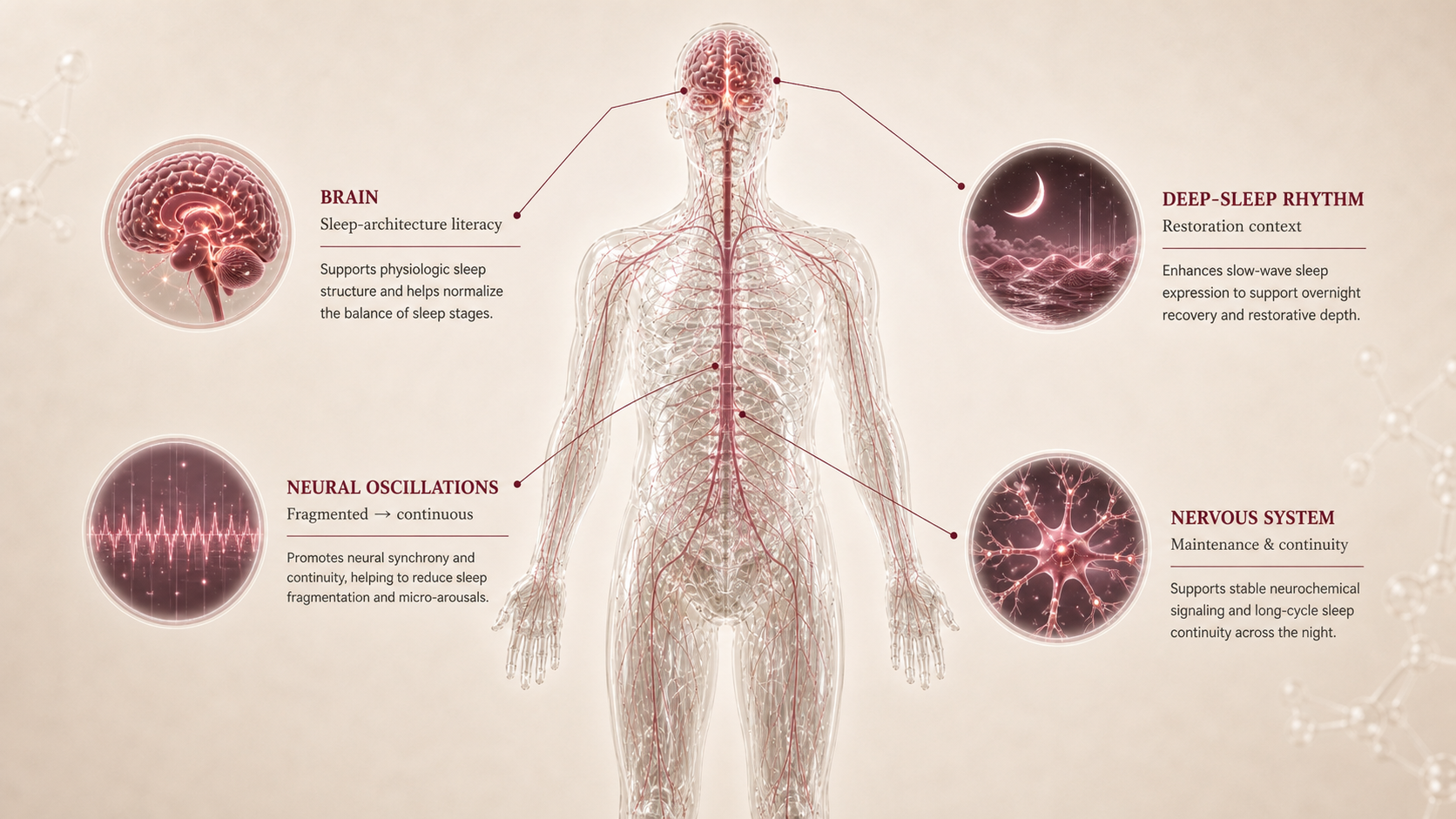
DSIP belongs in this niche because it clarifies sleep maintenance, fragmentation, and sleep-architecture literacy. The dossier separates mechanistic evidence, human sleep/rest outcomes, and regulatory or label evidence so the reader does not confuse plausibility with proof.
Why it may make sense for you
Ana's Sleep & Rest profile combines 5.5 hours of sleep, subjective quality 2/5, difficulty falling asleep and staying asleep, high stress, anxiety treated with an SSRI, next-day brain fog, occasional jet lag, suspected apnea, and recovery/gut context. DSIP is interpreted through that pattern, not as a generic sleep aid.
| Signal | Interpretation |
|---|---|
| Sleep pattern fit | Sleep maintenance, fragmentation, and sleep-architecture literacy. |
| Why it ranks here | Ana reports both difficulty staying asleep and low subjective sleep quality, so DSIP is relevant to the maintenance and architecture question. |
| Evidence boundary | Mixed and contradictory sleep literature; stronger as market-literacy content than as a proven outcome tool. |
| Main caution | The score is moderated by weak evidence maturity and possible apnea; fragmented sleep can be a breathing, medication, stress, pain, or reflux problem before it is a peptide problem. |
| Foundation check | Schedule regularity, caffeine, apnea, CBT-I, stress, pain/reflux, medication context, and recovery load remain the first layer. |
- Ana reports both difficulty staying asleep and low subjective sleep quality, so DSIP is relevant to the maintenance and architecture question.
- The dossier helps identify which sleep failure pattern is being discussed.
- The rank is educational and can support a clinician conversation.
- The score is moderated by weak evidence maturity and possible apnea; fragmented sleep can be a breathing, medication, stress, pain, or reflux problem before it is a peptide problem.
- Suspected apnea, SSRI context, chronic stress, caffeine load, and sleep deprivation can dominate the interpretation.
- The report does not turn rank into use instructions.
How it works
DSIP is historically discussed in relation to sleep regulation, delta-wave sleep, arousal thresholds, and sleep continuity. In this Blueprint, that history is useful for literacy, but it does not convert DSIP into a proven sleep-maintenance therapy.
| Pathway | Practical effect |
|---|---|
| Sleep pattern | Sleep maintenance, fragmentation, and sleep-architecture literacy. |
| Mechanism family | Sleep-regulation peptide / architecture and continuity claims. |
| Mechanistic evidence | Mechanistic evidence is tied to sleep-regulation and architecture claims, but the biological role and translation remain unsettled. |
| Plain boundary | Mechanism can explain plausibility, but it does not prove sleep treatment, apnea treatment, medication replacement, or combination benefit. |
DSIP is best read as a way to understand one sleep pathway. The pathway only matters if the real bottleneck is not better explained by schedule, light, caffeine, alcohol, apnea, stress, pain, reflux, medications, or training load.
What the evidence shows
DSIP is evaluated across three layers: mechanistic evidence, human sleep/rest outcome evidence, and regulatory or label evidence. This keeps Sleep & Rest conservative and avoids converting mechanism, anecdotes, or market interest into a sleep protocol.
| Study | Population | Key result | How to read it |
|---|---|---|---|
| Mechanistic evidence | Sleep-regulation peptide / architecture and continuity claims. | Mechanistic evidence is tied to sleep-regulation and architecture claims, but the biological role and translation remain unsettled. | Useful for pathway literacy. |
| Human sleep/rest outcome evidence | Outcome translation | Human sleep/rest outcome evidence is mixed and contradictory, with no basis for a guaranteed deep-sleep or maintenance claim. | Limited unless a specific approved label or robust sleep endpoint exists. |
| Regulatory / label evidence | FDA safety-risk compounding page for Emideltide (DSIP) plus sleep-architecture literature. | There is no approved sleep label for DSIP. FDA safety-risk materials list Emideltide (DSIP) among bulk substances with compounding safety-risk concerns. | Defines the practical boundary. |
- Direct sleep outcomes are limited or indirect for most compounds in this niche.
- Sleep-onset, maintenance, circadian timing, non-restorative sleep, pain, apnea, and medication-related sleep disruption should not be merged into one claim.
- Long-term safety, product identity, route, and combination use remain important unknowns for research-sensitive compounds.
Safety, side effects, and contraindications
- Route and product-context tolerability can vary, especially for research-sensitive compounds.
- Sleep, mood, next-day energy, appetite, edema, glucose symptoms, reflux, pain, or anxiety can shift for reasons unrelated to the peptide.
- Source quality and product identity are core safety variables outside approved labels.
- Suspected apnea, severe daytime sleepiness, chronic insomnia, SSRI or sedative medication context, heavy alcohol use, and medication changes should be reviewed before peptide interpretation.
- GH-axis compounds require extra caution around apnea, glucose, IGF-1, edema, endocrine disease, and cancer history.
- Pain, reflux, gut symptoms, and mental-health symptoms should not be masked rather than investigated.
- Pregnancy or lactation.
- Untreated or suspected sleep apnea when GH-axis compounds are being considered.
- Active cancer, unresolved oncology context, or endocrine disease without clinician review.
- Severe depression, suicidal ideation, dangerous parasomnias, narcolepsy suspicion, or falling asleep while driving.
- Chronic benzodiazepine, Z-drug, sedative, or alcohol dependence context without professional review.
For Ana, DSIP should be interpreted with suspected apnea, SSRI-treated anxiety, high stress, short sleep duration, and next-day brain fog in view. Foundation and evaluation come before peptide matching.
Reference protocol
Research-only sleep-architecture claim context: DSIP is anchored to FDA safety-risk compounding page for Emideltide (DSIP) plus sleep-architecture literature. This is Sleep & Rest education, not a personal sleep protocol, insomnia treatment, or combination recommendation.
- CBT-I or professional insomnia care
- Sleep-apnea diagnosis or CPAP treatment
- A sedative, hypnotic, benzodiazepine, Z-drug, or medication replacement
- A universal sleep protocol
- An application, preparation, acquisition, or scheduling instruction
- A claim that research-only material equals approved sleep therapy
| Item | Reference |
|---|---|
| Sleep pattern fit | Sleep maintenance, fragmentation, and sleep-architecture literacy. |
| Primary role | Classic sleep-architecture peptide with high market interest and high uncertainty. |
| Mechanistic evidence | Mechanistic evidence is tied to sleep-regulation and architecture claims, but the biological role and translation remain unsettled. |
| Human sleep/rest evidence | Human sleep/rest outcome evidence is mixed and contradictory, with no basis for a guaranteed deep-sleep or maintenance claim. |
| Regulatory / label evidence | There is no approved sleep label for DSIP. FDA safety-risk materials list Emideltide (DSIP) among bulk substances with compounding safety-risk concerns. |
| Application footprint | Not standardized here; this report does not publish application schedules or preparation instructions. |
- Identify whether the issue is sleep onset, maintenance, quality, circadian timing, stress-arousal, pain/gut discomfort, apnea, medication context, or recovery debt.
- Do not interpret a peptide until the main failure point is clear.
- Review sleep schedule, light exposure, caffeine, alcohol, late training, screens, temperature, stress, pain, reflux, apnea signs, and medication changes.
- Use sleep diary or wearable data as context when available, not as a standalone diagnosis.
- CBT-I, sleep-medicine evaluation, apnea workup, mental-health care, pain/gut diagnosis, and medication review come first when red flags exist.
- Peptivius keeps peptide discussion educational and non-prescriptive.
| Item | Reference |
|---|---|
| Reference mode | Research-only sleep-architecture claim context |
| Primary anchor | FDA safety-risk compounding page for Emideltide (DSIP) plus sleep-architecture literature. |
| Not included | No application schedule, preparation detail, acquisition pathway, or combination instruction. |
- Is the problem onset, maintenance, non-restorative sleep, circadian rhythm, stress-arousal, pain/gut discomfort, apnea, medication-related, or recovery-related?
- Are caffeine, alcohol, screens, shift work, jet lag, late training, reflux, pain, or stress large enough to explain the sleep pattern?
- Are snoring, witnessed pauses, daytime sleepiness, or non-restorative sleep strong enough to require apnea evaluation?
- Would CBT-I or a medication review answer the problem more directly than peptide matching?
- Can any change be interpreted without starting multiple sleep, recovery, or GH-axis compounds at once?
- Which sleep pattern is most important for the person.
- Whether the compound is read as onset, maintenance, circadian, recovery, or discomfort-overlap education.
- How strongly non-peptide foundations explain the problem.
- Sleep-apnea red flags should not be bypassed.
- Chronic insomnia should not be converted into a peptide experiment without CBT-I and clinical context.
- Benzodiazepines, Z-drugs, antidepressants, stimulants, alcohol, and sedatives require medication-context review.
- Research-only status should not be reframed as approved sleep therapy.
Administration details are intentionally not operationalized in this report. Sleep & Rest uses route only as category literacy.
- No application schedule, preparation detail, acquisition pathway, or combination instruction is provided.
- Route, product identity, compounding quality, and medication context can change the risk conversation.
- Sleep response should not be attributed to a compound if caffeine, alcohol, apnea, stress, pain, reflux, or medication changes are unresolved.
Maintenance means improving sleep regularity, continuity, quality, recovery, and safety, not staying dependent on a sleep compound.
- Track sleep schedule, latency, awakenings, rested feeling, daytime sleepiness, brain fog, caffeine need, pain/reflux, and adverse effects.
- If sleep remains poor, reassess diagnosis, apnea, medications, CBT-I, stress, pain, gut symptoms, and training load before adding mechanisms.
- The goal is restorative sleep literacy, not simply being knocked out at night.
| Question | Reference answer |
|---|---|
| Is this a sleep protocol? | No. It is category education and professional-conversation framing. |
| Can it replace CBT-I? | No. CBT-I remains a foundation for chronic insomnia context. |
| What if apnea is suspected? | Apnea evaluation comes before GH-axis or sleep-maintenance peptide interpretation. |
| Why no application schedule? | Because Peptivius is not a Protocol Builder and this report is educational only. |
DSIP has no Peptivius sleep protocol in this report. The reference block is limited to sleep-pattern literacy, evidence boundaries, and monitoring context.
- Do not treat a peptide as a sleeping pill.
- Do not bypass CBT-I, sleep-medicine evaluation, apnea workup, medication review, or mental-health care.
- Do not layer sleep, sedative, GH-axis, circadian, and recovery compounds without attribution.
- Do not treat research-only status as approved sleep therapy.
Monitoring and labs
- Bedtime, wake time, sleep duration, sleep latency, awakenings, rested feeling, daytime sleepiness, brain fog, and sleep diary.
- Caffeine amount and timing, alcohol, evening light/screens, late training, temperature, stress, anxiety, pain, reflux, and gut discomfort.
- Snoring, witnessed pauses, morning headaches, restless legs, parasomnias, shift work, jet lag, and suspected apnea.
- Medication review: SSRIs/SNRIs, stimulants, sedatives, benzodiazepines, Z-drugs, alcohol, antihistamines, antidepressants with sedating effects, and recent changes.
- Sleep latency, awakenings, subjective quality, energy, brain fog, caffeine need, mood, anxiety, pain/reflux, and GI symptoms.
- Snoring/apnea signals, daytime sleepiness, adverse effects, and whether routine changed.
- Whether the change is attributable or confounded by CBT-I, caffeine, travel, stress, training, medication, or pain changes.
- Sustained regularity, continuity, quality, and next-day recovery.
- Caffeine dependence, training recovery, mood stability, pain/reflux control, and need for sleep evaluation.
- Adherence to CBT-I or behavioral strategy when chronic insomnia is present.
The goal is not simply to be knocked out at night. It is to improve duration, continuity, quality, recovery, and safety.
Regulatory status & study stage
There is no approved sleep label for DSIP. FDA safety-risk materials list Emideltide (DSIP) among bulk substances with compounding safety-risk concerns.
| Item | Status | How to read it |
|---|---|---|
| Status | Research Only | Read only inside the stated anchor. |
| Sleep role | Classic sleep-architecture peptide with high market interest and high uncertainty. | Sleep maintenance, fragmentation, and sleep-architecture literacy. |
| Evidence maturity | Mixed and contradictory sleep literature; stronger as market-literacy content than as a proven outcome tool. | Mechanism, human sleep outcomes, and regulatory status are separate. |
- Human sleep/rest outcome evidence is mixed and contradictory, with no basis for a guaranteed deep-sleep or maintenance claim.
- Sleep claims should not be inferred from community use, sedative comparisons, or recovery anecdotes.
- Low; no approved sleep label and no reliable consumer protocol should be inferred.
- No commercial acquisition, preparation, application, or protocol guidance is provided.
This dossier does not convert label, research, supplement, or comparator context into consumer instructions.
Stacking and synergies
DSIP may appear in sleep-combination discussions online, but Peptivius keeps combination literacy at the niche level. This dossier evaluates the individual compound.
- Sleep routine, morning light, caffeine and alcohol review, stress reduction, CBT-I context, apnea evaluation, pain/reflux care, and training-load management.
- Professional review when medications, apnea, mood symptoms, endocrine context, or GH-axis compounds are involved.
- A sleep diary or wearable trend used as context rather than proof.
- Multiple sleep peptides layered to chase deep sleep without diagnosis.
- Sedative medication plus peptide experimentation without medication review.
- GH-axis compounds added when apnea, glucose, edema, or endocrine context is unresolved.
- Suspected apnea, severe daytime sleepiness, chronic insomnia, narcolepsy suspicion, severe mood symptoms, medication changes, sedative use, or heavy alcohol use.
- SSRI/SNRI, stimulant, benzodiazepine, Z-drug, hypnotic, sedating antidepressant, or multiple supplement context.
- Any attempt to combine sleep-active peptides with GH-axis, sedative, circadian, or recovery compounds.
More sleep mechanisms do not automatically mean better sleep. Layering onset, maintenance, circadian, GH-axis, and pain/gut pathways can make benefit and harm harder to interpret.
Genetic variable
DSIP has no validated consumer genetic response engine in Peptivius today. The genes below are pathway literacy only for circadian rhythm, arousal, stress, GH-axis, inflammation, or sleep-pressure interpretation.
- No validated consumer genotype determines this sleep peptide response.
- Pathway genes may help explain sleep timing, stress-arousal, sleep pressure, GH-axis, or inflammation differences.
- No SNP should convert a sleep peptide into a treatment recommendation.
Future DNA layers may improve sleep-pattern interpretation, but Slice 1 does not personalize Sleep & Rest from genotype.
Real-world reports
- Sleep anecdotes often mix peptides with melatonin, minerals, alcohol changes, caffeine changes, blue-light changes, training changes, sedatives, and travel.
- Users frequently describe vivid dreams, deeper sleep, calmer nights, or next-day fatigue without clear attribution.
- Research-only product quality and overconfident sleep-combination marketing are recurring concerns.
- No measurable change in sleep latency, awakenings, rested feeling, or next-day function.
- Worse anxiety, mood, dreams, edema, glucose symptoms, reflux, pain, or daytime sleepiness.
- Concern that peptide use is delaying apnea evaluation, CBT-I, medication review, or diagnosis.
- Anecdotes can reveal what users ask, but not what reliably improves sleep.
- The strongest read comes from pattern clarity, foundation correction, safety review, and repeatable sleep tracking.
- Sleep-combination marketing should be decomposed into onset, maintenance, circadian, recovery, pain/gut, and medication context.
Final personalized interpretation
For Ana, DSIP is interpreted against a mixed sleep pattern: short duration, low quality, difficulty falling asleep, difficulty staying asleep, next-day brain fog, high stress, SSRI-treated anxiety, occasional jet lag, suspected apnea, and recovery/gut context.
That pattern means the foundation matters more than a compound list. Regularity, light, caffeine timing, apnea evaluation, CBT-I context, stress reduction, pain/reflux review, medication context, and training recovery are the first layer.
DSIP is useful in the Blueprint because it explains one lane of the Sleep & Rest map. It does not replace sleep evaluation, apnea care, CBT-I, psychiatric care, pain/gut diagnosis, or medication review.
For Ana, DSIP is a professional-conversation topic and sleep-literacy anchor, not a use instruction.